

They Sound the Same — They're Not
When business owners start looking into options for their storefront or office windows, two terms keep coming up: window film and window tint. Most people use them interchangeably. That's a problem, because they refer to different products with different purposes, and choosing the wrong one can mean wasted money and a result that doesn't solve the actual issue.
Window tint is what most people think of first — the dark, shaded look you see on car windows. It reduces glare and blocks some heat by absorbing sunlight. It's a single-purpose product: make the glass darker.
Window film is a broader category that includes tint but goes much further. Films can reject heat without darkening a window. They can add privacy, block UV rays, reduce glare, hold shattered glass together, or turn a plain window into a branded surface. The technology behind modern films is engineered at the molecular level — ceramic and spectrally selective films, for instance, can block over 90% of infrared heat while still letting in natural light.
Why the Difference Matters for Your Business
If you run a retail space with big display windows, a dark tint defeats the purpose. Customers can't see your merchandise. What you probably need is a clear or nearly clear heat-rejection film that keeps the interior comfortable without turning your storefront into a cave.
If you're in an office building with a west-facing wall of glass, you're fighting afternoon heat gain that drives up cooling costs. A spectrally selective film can cut that heat load significantly without changing the look of the building. That's not something basic tint can do — at least not without making every window dark enough to need the lights on at noon.
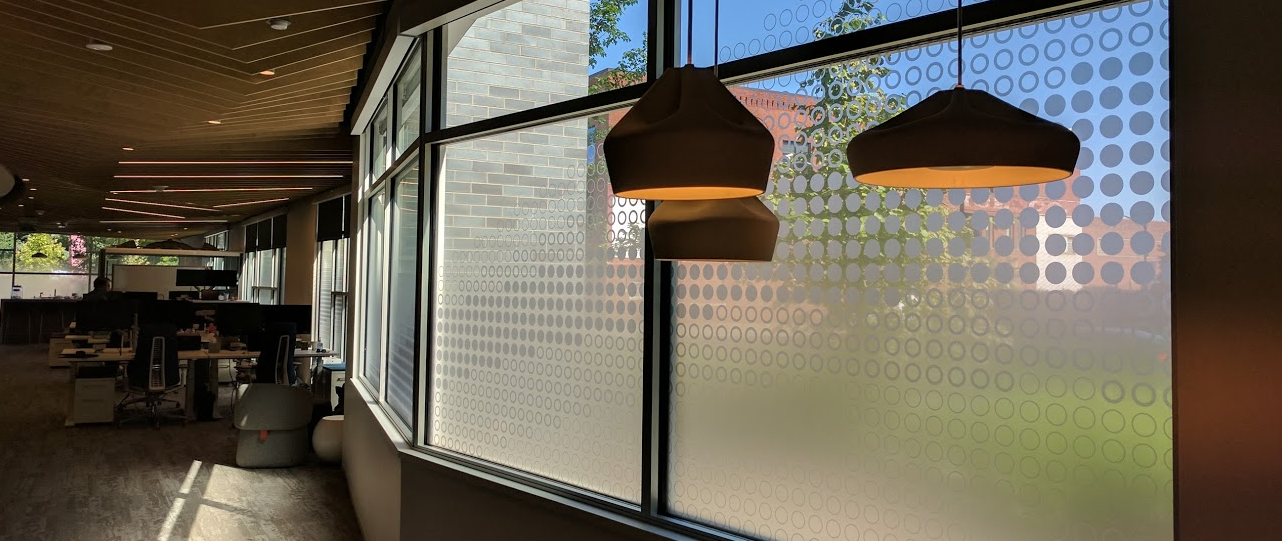
If you want privacy for a conference room or a medical office, frosted or decorative film gives you that without permanent etching or expensive glass replacement. Some films even allow one-way visibility during the day.
The UV Factor
This one surprises a lot of business owners. UV damage isn't just a skin concern — it's a merchandise and interior concern. Ultraviolet light fades carpet, furniture, signage, product displays, and artwork. Over months and years, the sun bleaches everything it touches.
Most quality window films block 99% of UV radiation regardless of how dark or light they appear. Basic automotive tint does block UV too, but commercial-grade films are designed to last longer and perform under the more demanding conditions of larger glass surfaces and constant sun exposure.
Installation and Warranty Coverage
Commercial window film is applied as a precision-cut adhesive layer directly to the interior surface of the glass. When installed correctly, there are no bubbles, no peeling edges, and no visible seams.
What matters most to business owners is what's behind the product. We use 3M films and components, which means our finished graphics are eligible for the 3M MCS Warranty — the most comprehensive finished graphics warranty in the industry. It's non-prorated, meaning you get full coverage for the entire warranty period, not a sliding scale that pays less as time goes on.
Quality matters enormously here. Bargain films degrade fast — they turn purple, bubble, and peel within a few years. The adhesive breaks down and leaves a haze on the glass that's difficult to remove. Going cheap on window film almost always costs more in the long run. With warranted 3M materials and professional installation, you're getting a product that's been tested at 3M's outdoor weathering facilities and backed by real coverage if something goes wrong.
Decorative and Branding Applications
Beyond the functional benefits, window film opens up a whole range of branding possibilities. Custom-printed films can turn plain glass into branded surfaces — logos, patterns, gradient effects, or full-color graphics that transform your space.
Frosted vinyl strips at eye level can add a professional look to glass conference rooms or office partitions. Perforated window film lets you display graphics on the outside while maintaining visibility from inside — a technique commonly used for storefronts and vehicle windows alike.
How to Choose
Start with the problem you're trying to solve. If it's heat, look at spectrally selective or ceramic films and compare their solar heat rejection ratings. If it's privacy, look at frosted or one-way mirror films. If it's branding, talk to a print shop that handles both printing and film installation — getting the print quality and the installation right are equally important.
Don't default to "just get it tinted." That might be the right answer for a car, but for a business, you have better options available. The right film can improve comfort, protect your interior, cut energy costs, and reinforce your brand — all from a single product on your windows.
Ready to Get Started?
Contact Extreme Color today for vehicle wraps, signs, banners, and more.
Get a Free Quote