

When People Can't Find Their Way, That's a Sign Problem
You've probably experienced it yourself — walking into an unfamiliar office building, medical complex, or retail center and having no idea where to go. You look around for some kind of directional sign, and either there isn't one, or the one that exists is a faded paper printout taped to the wall with an arrow drawn in marker.
That's not just an inconvenience for visitors. It's a problem that reflects directly on the business or property. When people can't navigate your space easily, they get frustrated before they ever interact with your staff. For medical offices, that frustration hits patients who are already stressed. For corporate campuses, it makes a bad first impression on clients and candidates. For retail environments, confused customers leave.
Wayfinding signage solves this — but only when it's designed and placed with real thought behind it. A directory in the lobby and a few arrows in the hallway isn't a wayfinding system. It's a starting point.
What Wayfinding Signage Actually Includes
A complete wayfinding system typically involves several types of signs working together. Understanding the categories helps you think about what your space actually needs rather than just ordering a few generic signs and hoping they cover it.
Identification signs tell people they've arrived at the right place. These are the signs on or next to a door that say "Suite 204 — Dr. Smith's Office" or "Conference Room B." They seem obvious, but plenty of commercial spaces skimp on these or use inconsistent formatting that creates more confusion than it solves.
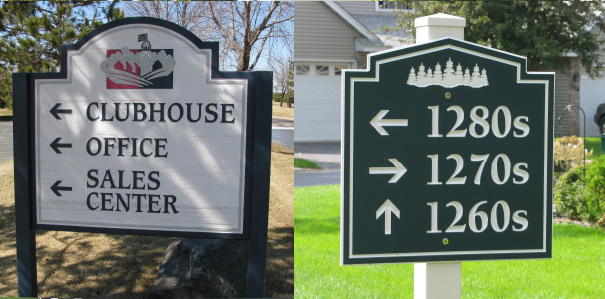
Directional signs are the arrows-and-text signs placed at decision points — hallway intersections, elevator lobbies, stairwells, parking garage entries. The key word here is "decision points." A directional sign in the middle of a straight hallway with no turns isn't helping anyone. A directional sign at the T-intersection where people actually have to choose left or right is doing its job.
Informational signs cover everything from building directories and floor maps to "you are here" displays. These are the signs people seek out when they need to orient themselves in a larger space. They're especially important in multi-tenant buildings, hospitals, and campus environments where the layout isn't intuitive.
Regulatory signs include fire exit markers, accessible route indicators, and other code-required signage. These aren't optional, and they have specific requirements that need to be met. Some regulatory signs — like ADA-compliant room signs with Braille and tactile lettering — require specialized production, so it's important to identify which signs in your system fall into this category early in the planning process.
The Design Principles That Make Wayfinding Work
Effective wayfinding isn't just about having signs — it's about having the right signs in the right places with the right information presented clearly. A few principles separate good wayfinding from decorative clutter.
Consistency is everything. Every sign in your wayfinding system should use the same fonts, colors, iconography, and layout conventions. When a visitor sees a blue sign with white text at the entrance, every directional sign throughout the building should follow that same pattern. Inconsistency forces people to re-learn how to read your signs at every turn, which defeats the entire purpose.
Less text is more effective. A directional sign should communicate its message in the time it takes someone to glance at it while walking. If a visitor has to stop and read a paragraph to figure out where to go, the sign has failed. Short labels, clear arrows, and universally understood icons do more work than detailed written instructions.
Placement matters as much as design. Signs need to be visible at the moment a decision needs to be made. That means mounting them at eye level, ensuring they're not blocked by open doors or seasonal decorations, and lighting them adequately. A perfectly designed sign mounted above a dropped ceiling where nobody looks is worthless.
ADA Compliance Isn't Optional
The Americans with Disabilities Act sets specific requirements for signage in commercial and public buildings. These aren't suggestions — they're legal requirements, and getting them wrong can result in complaints, lawsuits, and costly retrofits.
ADA sign requirements cover permanent room identification signs — restrooms, offices, conference rooms, and other spaces with a defined function. The specifications include raised characters, Braille, non-glare finishes, specific contrast ratios, and precise mounting locations. These are specialized products that require dedicated ADA sign vendors, so plan for them as a separate line item in your wayfinding project.
What catches many property managers off guard is that ADA requirements have been updated over the years, and signs that were compliant when originally installed may no longer meet current standards. If your building's room signs look like they were installed in the 1990s, it's worth having them evaluated. As a sign printing in Marietta shop, we see this come up often when helping clients plan comprehensive wayfinding systems — the directional and identification signage we produce needs to work hand-in-hand with the ADA-compliant pieces sourced from specialized vendors.
Materials and Production for Interior Signage
Interior wayfinding signs can be produced from a wide range of materials depending on the look you're going for and the environment they'll live in. Common options include acrylic, aluminum, PVC, and various composite panels.
Acrylic is popular for a clean, modern look. It can be printed directly, painted, or fabricated with standoff mounts for a dimensional effect. It works well for directories, room signs, and decorative wayfinding elements in corporate and medical environments.
Aluminum is durable, lightweight, and takes printed graphics well. It's a strong choice for high-traffic areas where signs might take some abuse, and it's common in parking garages and industrial or institutional settings.
PVC and foam board options are lighter and more affordable, making them suitable for temporary wayfinding needs — event signage, construction-phase directories, or seasonal retail layouts that change frequently.
The production method also matters. Direct printing, vinyl application, engraving, and dimensional lettering all have different strengths. A sign printing in Marietta operation with wide format capabilities can produce most wayfinding signage in-house, which means faster turnaround and more control over quality compared to ordering through a catalog or online service.
Planning a Wayfinding System: Where to Start
If your building or commercial space needs better wayfinding, the process starts with walking the space the way a first-time visitor would. Enter through every entrance. Take every elevator and stairwell. Walk every hallway. At each point where you have to make a decision about where to go, note whether there's a sign helping you make that decision — and whether that sign is clear, visible, and accurate.
This walkthrough almost always reveals gaps that people who work in the building every day have stopped noticing. The conference room that everyone just knows is "the second left past the kitchen" — a visitor doesn't know that. The parking garage elevator that opens into a hallway with four unmarked doors — that's a wayfinding failure waiting to frustrate someone.
Once you've mapped the decision points and identified gaps, you can plan what types of signs are needed, where they should go, and what information each one needs to communicate. That's the foundation of a wayfinding plan, and it's the starting point for getting signage produced that actually solves the problem rather than just decorating the walls.
The Bottom Line
Good wayfinding signage is one of those things people only notice when it's missing. When it works, visitors move through your space smoothly, find what they're looking for, and arrive at their destination without frustration. When it doesn't work — or doesn't exist — every visitor has to figure out your building on their own, and the impression that leaves isn't a good one.
Whether you're building out a new commercial space, renovating an existing property, or simply tired of giving directions to every person who walks through your lobby, a well-planned wayfinding signage system is a practical investment that pays for itself in visitor experience. And for properties in the Marietta and greater Atlanta area, working with a local sign printing in Marietta partner who can handle everything from ADA-compliant room signs to full building directory systems makes the process significantly easier.
Ready to Get Started?
Contact Extreme Color today for vehicle wraps, signs, banners, and more.
Get a Free Quote