

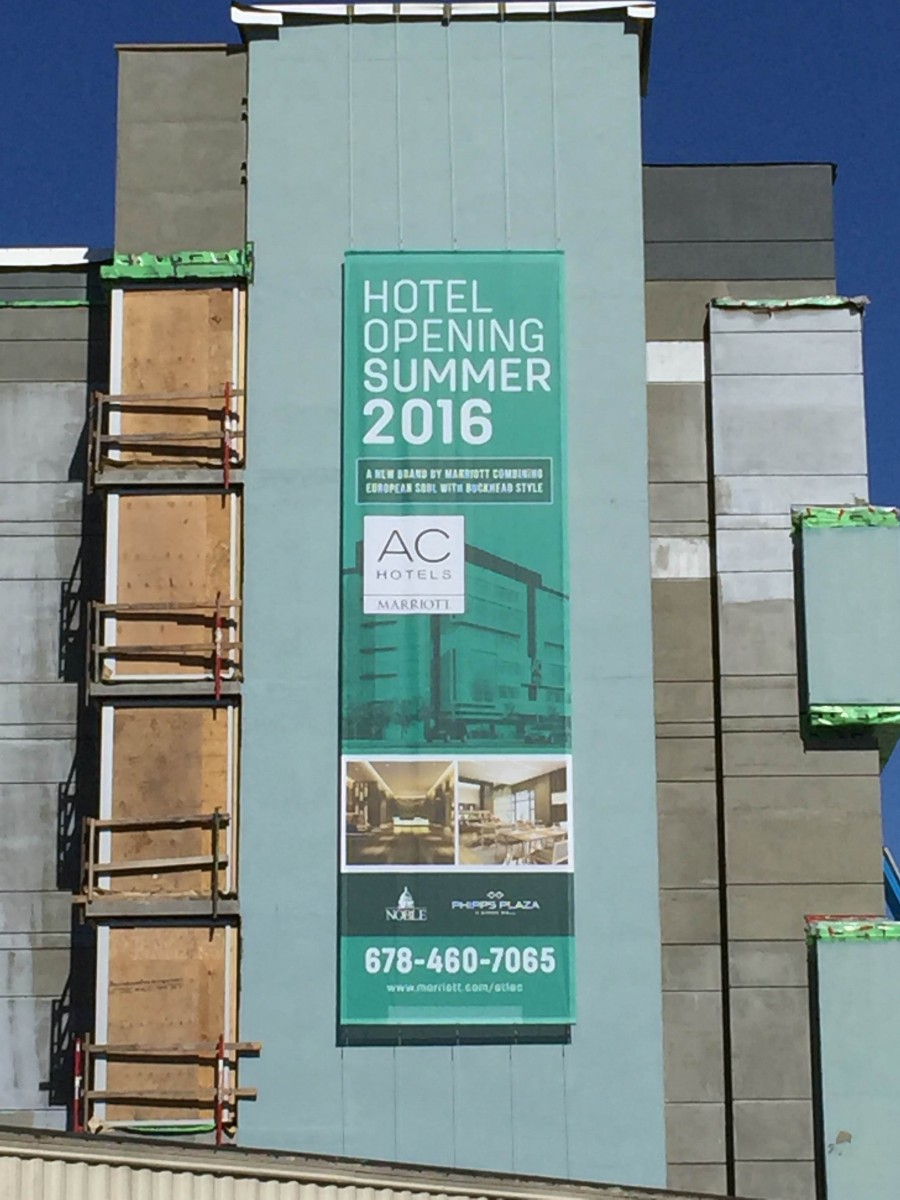
A vinyl banner looks like the simplest product we make, and in a way it is. But the gap between a banner that looks crisp and hangs flat for a whole season and one that sags, tears at the corner, and flaps itself to pieces in the first storm comes down to a handful of choices most people never think about. If you are ordering a banner for an outdoor event anywhere around Atlanta, here is what actually matters.
Start With the Material Weight
Vinyl banner material is measured in ounces per square yard, and that weight tells you how the banner will behave. Lighter material is fine for short-term indoor use or a one-day event under cover. For anything that lives outdoors, especially through Atlanta's afternoon thunderstorms and summer wind, heavier material holds up far better. It resists stretching, it handles wind load with less flapping, and it is less likely to tear at a grommet.
We match the weight to the job. A banner hanging on a fence at a weekend festival in Piedmont Park has different demands than one zip-tied to an overpass railing for a month or strung across a building entrance off Marietta Street. Telling us where and how long a banner will hang lets us spec the right material instead of defaulting to the cheapest stock.
Mesh Versus Solid Vinyl in the Wind
One of the most important choices for outdoor banners is solid vinyl versus mesh. Solid vinyl gives you the richest color and full opacity, but it acts like a sail. In a windy spot, a large solid banner catches every gust, which strains the hardware and the material. Mesh banner material is perforated with thousands of tiny holes that let wind pass through, dramatically reducing that sail effect.
For a big banner on an exposed fence, a building face, or anywhere wind is a factor, mesh is often the smarter choice even though it gives up a little color saturation and lets some light through. For a smaller banner or one in a sheltered spot, solid vinyl keeps the graphics as bold as possible. We help you weigh that tradeoff based on the size and the location.
Finishing: Hems and Grommets Are Not Optional
The edge of the banner is where failures start. A raw, unfinished edge tears. That is why we hem the perimeter, folding the material over and welding or sewing it so the edge is doubled and reinforced. Then grommets, the metal rings you thread rope or zip ties through, get set into that reinforced hem rather than into single-layer material. A grommet punched into an unhemmed edge will rip out under load. A grommet set in a proper hem holds.
We space grommets based on banner size. A small banner might need them only at the corners, while a large outdoor banner needs them every couple of feet so the load is distributed and the material stays taut between attachment points. Too few grommets and the banner bows and flaps between them, which is both ugly and how tears begin.
Pole Pockets and Reinforced Corners
Grommets are the default, but they are not the only finishing option. If your banner slides onto a pole or a crossbar, like a banner that hangs from a horizontal pipe at a trade booth or an entrance, a pole pocket is the right call. That is a sewn sleeve along the top, bottom, or both edges that the pole passes through, giving a clean, taut hang with no visible hardware. For banners that take real abuse, reinforced corners with extra material add strength exactly where the stress concentrates.
How You Hang It Matters as Much as How It Is Made
Even a well-built banner fails if it is hung wrong. The goal is even tension on all sides. Pulling tight at the corners while leaving the middle slack invites flapping and wind damage. We recommend running rope or heavy zip ties through every grommet, not just the corners, and tensioning the banner evenly so it sits flat. On a fence, that means tying off at each grommet along the rail. In an open span, it means tensioning top and bottom so the banner cannot billow.
For Atlanta's weather specifically, plan for wind and rain. A banner that is drum-tight and perforated where it needs to be will ride out a summer storm. A loose, solid banner with four corner ties is the one you find on the ground the next morning.
Design for Distance and Sun
The same legibility rules that govern any large-format graphic apply to banners. Big, simple, high-contrast messaging reads from across a parking lot or a festival field. Fine print and pale colors wash out, especially under Atlanta's bright, direct summer light. We design banners to carry one clear message at distance, with contact details secondary, because a banner that tries to say everything ends up readable by no one.
The Practical Takeaways
Choose your material weight for how long and where the banner will live, pick mesh over solid when wind is a real factor, and never skip proper hems and well-spaced grommets. Use pole pockets when you are hanging from a bar, hang the finished banner with even tension on every grommet, and design it bold enough to read at distance in full sun. Get those choices right and a vinyl banner is one of the most cost-effective signs you can buy.
Our team produces banners for events, storefronts, and venues across metro Atlanta, and we are glad to talk through material, finishing, and hardware before we print so your banner is built for exactly where it is going to hang.
Ready to Get Started?
Contact Extreme Color today for vehicle wraps, signs, banners, and more.
Get a Free Quote