

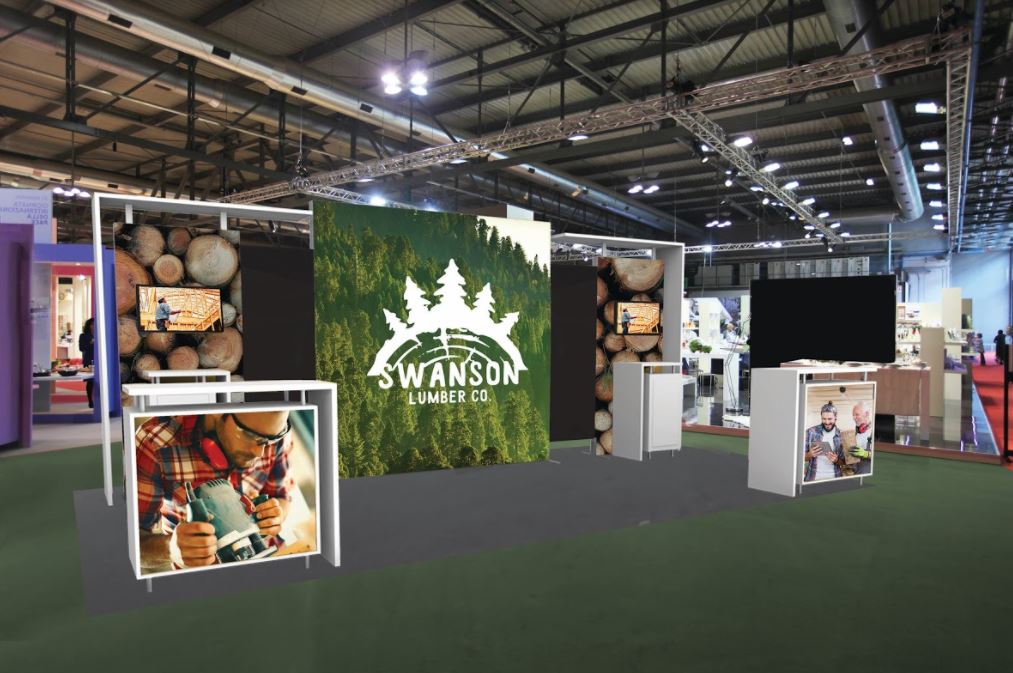
The Problem with Most Trade Show Booths
You've paid for your floor space, shipped your display, and set up your booth. Then you look around and realize the company two booths down has bolder graphics, more cohesive branding, and a backdrop drawing people in from across the aisle. Trade show competition is visual, and printed graphics are the biggest lever you have over how your booth performs before you say a word to anyone.
The gap between an average booth and a strong one usually comes down to intentional decisions — not a bigger budget.
What Makes Trade Show Print Different
Printing for a trade show isn't the same as printing for a lobby or a storefront. Viewing distance changes everything. Graphics seen from 10–15 feet away can tolerate a lower effective resolution than something a person will stand next to and read. That's not a limitation — it means larger graphics don't require impractically large file sizes, as long as resolution is calculated correctly for the intended viewing distance.
The substrate matters just as much as the image. Fabric tension displays, rigid foam board panels, retractable banner stands, and SEG (silicone edge graphic) frames all have different structural properties, portability requirements, and print surface characteristics. What works as a pop-up backdrop won't work as a tabletop display.
Sizing and Specs: Get These Right Before You Design
One of the most common ways trade show graphics go wrong is incorrect sizing. Booth dimensions vary by show, by floor configuration, and by what was actually ordered. Before your designer touches a layout, confirm the exact dimensions of your booth space, your display hardware, and any graphic panels. Rebuild your design files to bleed specifications — bleed requirements on tension fabric systems differ from those on rigid panels.
This is especially critical for modular setups where panels tile together. A misaligned seam across your brand's logo is not something you want to discover on setup day in Atlanta or anywhere else.
Design for the Environment, Not Just the Eye
Trade show halls are loud, lit inconsistently, and intensely competitive for attention. Colors that look strong on screen — or even in a standard print proof — can shift under fluorescent overhead lighting. We factor in how ambient and exhibit lighting will interact with your chosen substrate, because the relationship between a graphic and its light source is part of what makes the final result work.
Glare is a real problem with many rigid substrates. Matte laminations, fabric tension systems, and certain coated materials reduce unwanted reflections significantly. If your booth gets hit with overhead LED strips, a high-gloss surface can wash out your entire message.
Color Consistency Across Every Printed Piece
A trade show presence is rarely just one element. There's a back wall, a tabletop display, a banner stand, literature holders, maybe a hanging overhead sign. Each piece is likely printed on a different substrate — potentially through a different process. Getting consistent color across all of them is a technical challenge that requires careful color management, not just matching numbers on a brand spec sheet.
This is one of the clearest arguments for sourcing your entire booth package through a single large format print provider. When we control all the components, we calibrate output across substrates so everything arrives looking like it was designed as a system — because it was.
Plan for Reusability from Day One
One of the smartest investments in trade show graphics is engineering them for repeated use before the first show. That means choosing substrates that roll, fold, or crate without damage. It means designing with enough flexibility that the graphics don't look dated after one show cycle. It means using frame systems where only the graphic panels swap out for updates — not the entire hardware investment.
For Atlanta businesses that exhibit multiple times a year, designing for longevity significantly lowers the cost-per-show. A well-built display that travels cleanly and refreshes easily is worth far more than a one-time setup you're replacing after every event.
What to Do Right Now
If you have a show coming up, the most valuable thing you can do today is confirm your exact booth dimensions and hardware specifications. Get that information to your designer before anything else. Everything downstream — file setup, substrate choice, graphic sizing, production lead time — depends on having accurate specs from the start.
Large format trade show graphics require time to produce correctly. Rushing that process is how problems show up on setup day. Start early, work from confirmed specs, and think about the full booth system rather than individual pieces in isolation. That mindset is what separates booths that look assembled from booths that look built.
Ready to Get Started?
Contact Extreme Color today for vehicle wraps, signs, banners, and more.
Get a Free Quote