

The Print You Never See On Screen
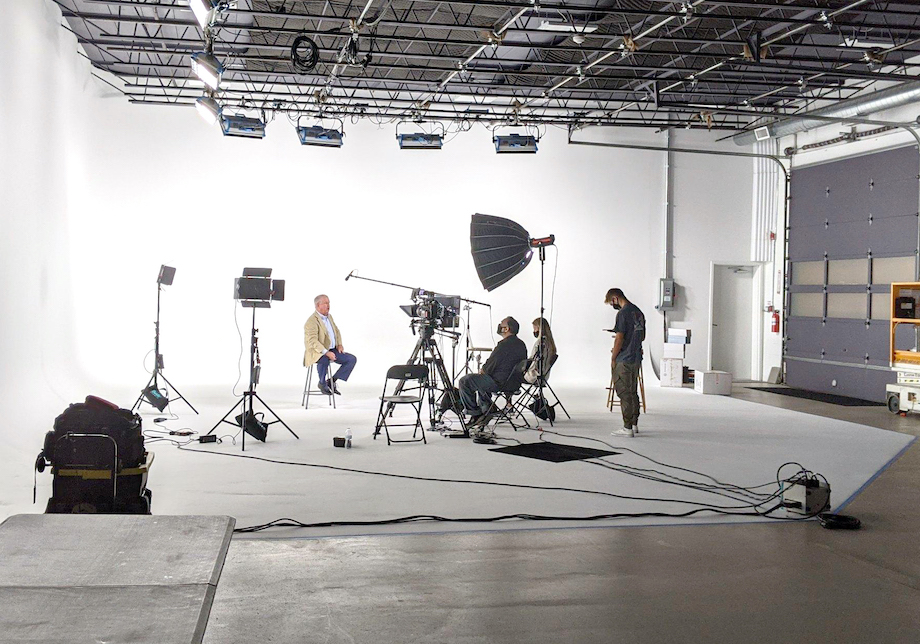
Atlanta has become one of the busiest production hubs in the country, and most people picture the glamorous side of it: the sets, the storefronts, the period cars. But a huge amount of the print a production orders never appears on camera at all. It lives on the stage floor, behind the lens, and around the edges of the frame, and it is every bit as essential as the graphics the audience actually sees.
We work with productions across the metro, from the big stages out toward the Eastside studios to one-day shoots downtown, and the behind-the-camera print is some of the most time-sensitive work we do. When a crew of two hundred is standing around waiting, print that is wrong or late is not an inconvenience. It is money burning by the minute.
Floor Markings and Spike Marks
Start at the floor. Every stage is covered in markings that tell the crew where things go: actor positions, camera marks, set boundaries, safety zones. Traditionally these are spike tape, but productions increasingly want printed floor graphics for repeatability, for cleaner looks on multi-camera setups, and for complex blocking that tape cannot communicate clearly.
Printed floor markings have to do two things at once. They have to grip a stage floor and survive being walked on by a full crew all day, and they have to come up cleanly when the scene wraps without leaving residue on an expensive sprung floor. That balance, durable underfoot but removable without damage, is the whole engineering problem, and it is the kind of thing we spec carefully for the surface the production is actually shooting on.
Backdrops, Backings, and What Fills a Window
Look out the window of almost any interior set and what you see is often a giant printed backing. Translights and backdrops give a soundstage its sense of place, turning a windowless box into an apartment overlooking a city or a diner on a desert highway. These are large format prints at serious scale, and the quality of the image is what sells the illusion that the set has an outside world.
The same goes for the seamless backings behind product shots, the muslin-style backdrops in a photo unit, and the oversized graphics that stand in for a view. None of these are the star of the scene, but a seam in the wrong place or a color that reads wrong on camera pulls a viewer out of the moment. Getting the scale and the image right is the difference between a backing that disappears into the story and one that announces itself as fake.
Crew-Facing Signage and On-Set Logistics
A working set is also a workplace, and it runs on signage most viewers never think about. Directional signs guiding crew and background talent across a large lot. Department and zone labels. Safety and restricted-area notices. Parking and basecamp signage when a production takes over a stretch of a neighborhood for the week. On a sprawling shoot, this wayfinding is what keeps hundreds of people moving in the right direction.
This is unglamorous work, but it is exactly where a local shop earns its keep. When a production lands in Atlanta and needs basecamp signage printed and ready before the trucks roll in, proximity and turnaround matter more than anything fancy. Being here, in the same city, is the service.
Why Productions Keep a Print Partner Close
The common thread across all of this is speed under pressure. Productions change plans constantly. A location shifts, a scene gets added, a director decides the backing needs to be bigger. The print partner who can absorb those changes without drama is worth far more than one who is merely cheap, because the cost of waiting on set dwarfs the cost of the print itself.
We specialize in large format printing and signage, which lines up neatly with what behind-the-camera work demands: big images, durable materials, and the flexibility to handle whatever the shooting schedule throws at us. The productions we work with tend to come back not because any single job was extraordinary, but because the print was right and it was there when they needed it.
Practical Takeaways for Atlanta Productions
If you are running a production here, think about your behind-the-camera print as early as your on-camera print. Floor markings, backings, and crew signage are easy to leave until the last minute, and the last minute is exactly when they are most expensive to get wrong.
Build a relationship with a local shop before you need one, so that when the schedule shifts, you already have a partner who knows your project and can turn work around fast. The print the audience never sees is what lets the crew do its job, and on a production that runs on the clock, that quiet reliability is the whole point.
Ready to Get Started?
Contact Extreme Color today for vehicle wraps, signs, banners, and more.
Get a Free Quote