

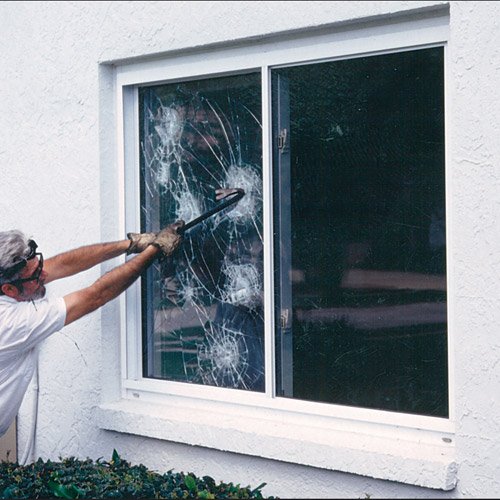
Glass Is the Weakest Point
Walk any Atlanta retail corridor and look at how much of the storefront is glass. Doors, display windows, transom panels, sidelights — sometimes the entire front of the building is essentially a sheet of glass with a frame around it. That glass does a lot of work: it sells, it lets light in, it advertises. It also breaks easily.
Security window film exists for a reason. It doesn't make glass unbreakable, but it changes what happens when glass breaks — and for storefronts, offices, and schools in metro Atlanta, that change is the whole point.
What Security Film Actually Does
Security film is a thick, optically clear polyester layer applied to the interior surface of existing glass. When the glass cracks or shatters, the film holds the shards together. A brick that would have gone through a window now bounces back. A storefront that would have been emptied in 90 seconds during a smash-and-grab becomes a 5-minute, noisy effort — long enough for alarms to do their job and for the thieves to give up.
It's not a magic shield. With enough time and the right tools, anything can be defeated. What security film buys is delay, deterrent, and the prevention of injury from flying glass.
Smash-and-Grab Protection
Smash-and-grab robberies are an opportunistic crime. The economics depend on speed. A thief expects to be in and out of a storefront in well under a minute, with merchandise grabbed off shelves nearest the broken window. Add several minutes of frustration banging on intact, film-bonded glass with a hammer, and the math stops working.
We install security film for jewelry stores, cell phone retailers, boutiques, dispensaries, and any business with high-value, easily-pocketed inventory near the glass. The film is invisible from the street. The only people who know it's there are the thieves who try and fail.
Severe Weather and Flying Debris
Atlanta gets weather. Storm systems push through the metro every spring and summer with high winds, hail, and the occasional tornado warning. Most glass injuries from severe weather come not from people being thrown into windows but from windows being thrown into rooms — shards traveling at high speed across an office, retail floor, or living room.
Security film changes that physics. Wind-driven debris that would have shattered the glass into the room instead cracks the glass while the film holds the pieces in the frame. The same logic applies to hailstorms, accidental impacts, and explosions in industrial buildings.
Accidental Breakage and Liability
A lot of glass breaks for boring reasons. A delivery dolly rolls into a door. A kid runs into a sliding glass panel. A chair gets knocked into a conference room divider. Without film, that's an immediate liability event — sharp glass on the floor, possible injuries, an emergency call to a glass replacement company, and a business that's "closed" until the front gets boarded up.
With film, the broken pane stays in place. It looks bad, but it's stable. The business stays open until the glazier shows up. Nobody gets cut.
Film Thickness and Anchor Systems
Not all security film is the same. Thinner films offer modest improvements and are mostly useful for stopping injury from accidental breakage. Mid-range films are the workhorse for smash-and-grab protection on standard storefront glass. Heavy films are used for higher-threat environments.
The film alone doesn't stop a window from being pushed in as a single sheet — for that, an anchor system bonds the edge of the film to the window frame using a structural sealant. Film with anchors stays in the opening even after the glass fails completely, which is the difference between a smash-and-grab being slowed and being stopped.
Combining Security With Other Window Goals
Most of the buildings we film aren't just thinking about security. They want to reduce solar heat, improve UV protection for merchandise, add privacy, or do all three. Modern security films come with optional solar and tinted variants that combine those functions in one layer, so businesses don't end up stacking films on the same glass.
For a retail building on a sunny exposure — anywhere along Peachtree, in Buckhead, or in the West Midtown corridor — combining a solar layer with security thickness gives the building heat rejection, UV protection, and breakage protection in one install.
What the Installation Looks Like
A typical security film install happens on the interior of the glass. We clean the surface to a level most cleaning crews never reach, cut the film slightly oversized, slip it into position with a slip solution, and squeegee it down. Anchor systems are applied around the perimeter where required. For a typical storefront, the work can usually be done in a day, and the business can be open the same day in most cases.
The film cures over a few weeks. During that time it may look slightly hazy in spots — that's the slip solution working its way out. By the end of the cure, the film is invisible.
Who Should Be Looking at This
Any business with valuable inventory behind glass, any school or office concerned about active threats, any landlord trying to limit liability from accidental breakage, and any owner of a building in a tornado-prone area should at least price out security film. It works on the windows already in the building, with no need to replace the glass itself.
The right starting point is a walk-through. We look at the glass, the exposures, the threat model, and the building's other goals — solar, UV, privacy — and put together a recommendation that balances cost against the actual risk.
Ready to Get Started?
Contact Extreme Color today for vehicle wraps, signs, banners, and more.
Get a Free Quote