

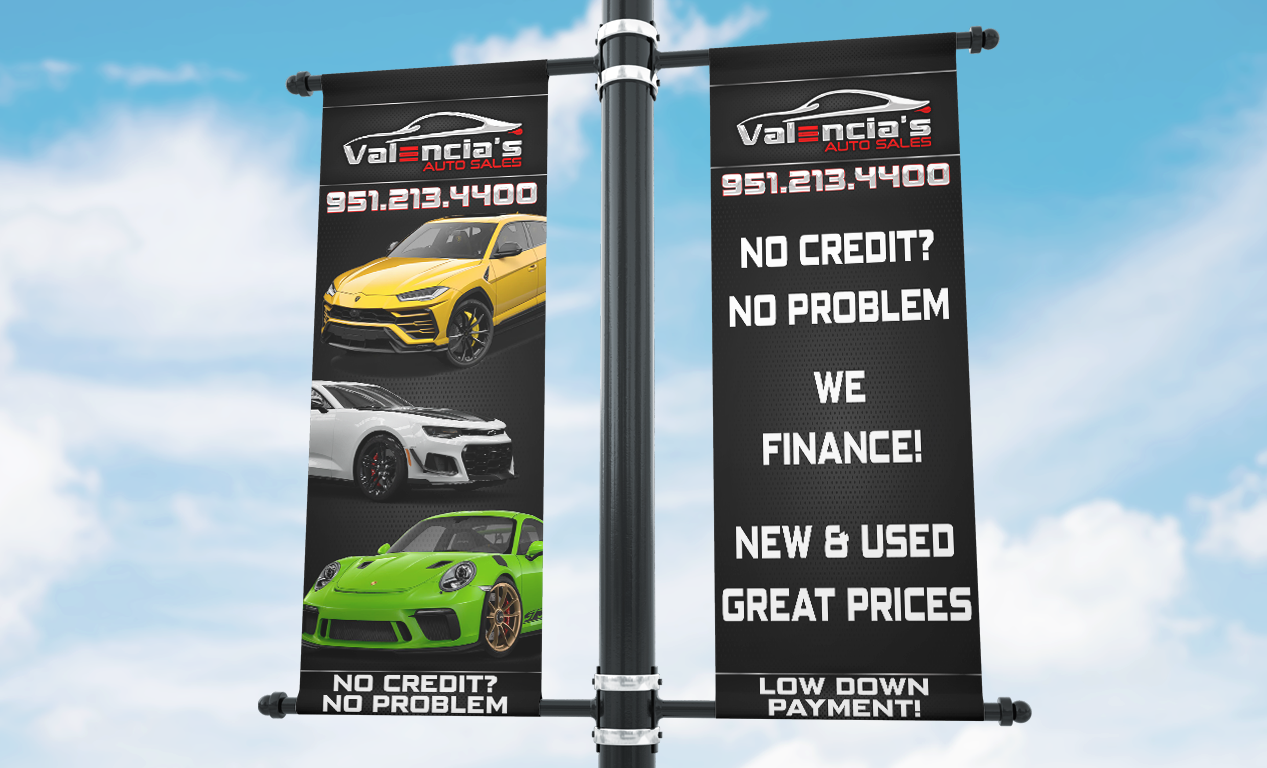
The Banners That Tell You Where You Are
Drive into Midtown or down Peachtree and you can tell what neighborhood you're in before you see a street sign. Decorative banners hanging from light poles announce the district — Castleberry Hill, Inman Park, the Westside, Buckhead Village. The banners are doing what neighborhoods used to do with architecture: signaling identity, ownership, and pride.
Pole banners are one of the most efficient pieces of urban signage a district can commission. They're highly visible, easily updated, and create a brand presence over a long corridor without permits for new permanent structures. We've printed and produced pole banner programs for BIDs, CIDs, business associations, neighborhood groups, and cultural institutions across metro Atlanta.
What Pole Banners Are Actually For
Pole banners do three jobs that nothing else does as well. First, they define a district visually — the moment a driver or pedestrian crosses into the banner zone, they know they're somewhere specific. Second, they market events — festivals, exhibitions, parades, season programs. Third, they brand the place over time, building a recognizable identity that locals and visitors associate with the district.
A well-run banner program rotates seasonally or even monthly. Spring banners for the cherry blossom festival, summer banners for the music series, fall banners for arts month, holiday banners for December. The poles are the same. The story changes.
Materials and Construction
Pole banners take wind. A lot of it. A 24" x 60" banner mounted ten feet up a light pole is essentially a sail, and Georgia weather doesn't go easy on it. We build pole banners for that reality. A common material is heavy-duty blockout vinyl, double-stitched on the edges, with pole pockets at top and bottom and reinforced grommets where the brackets attach.
Blockout vinyl matters because pole banners are usually printed on both sides. Without a blockout layer in the middle, the print bleeds through and looks washed out from the back. A proper pole banner has crisp, full-color art on both faces.
Brackets, Spreaders, and Hardware
The banner is only as good as the hardware holding it. Standard pole banner brackets are heavy aluminum or steel arms that bolt around the pole and accept a fiberglass spreader rod through the banner's pole pocket. Done right, the system flexes in wind without ripping the banner or pulling the brackets off the pole.
Atlanta's poles are not uniform. City poles, GDOT poles, decorative district poles, and utility-owned poles all have different diameters and different approval processes. We work with the BID or district to confirm what's permitted on each pole before printing anything, because a beautifully designed banner that can't be installed is a budget waste.
Permitting and Approvals
Pole banners almost always require some level of approval. The City of Atlanta has a process for banner permits on public right-of-way. GDOT has its own process for state-controlled corridors. Private decorative poles in a development like Atlantic Station or Ponce City Market have their own internal approvals.
The lead time matters. Permits can take weeks. We've helped districts navigate this enough to know that the print is rarely the bottleneck — the paperwork is. The smart move is to start the permitting conversation in parallel with the design phase, not after.
Design Principles That Make Pole Banners Work
A pole banner is read from a car at 35 miles per hour, from a sidewalk across two lanes of traffic, or from the window of a passing bus. It's not a brochure. The design has to land in two seconds.
That means big, simple type. Strong contrast between the background and the foreground. One clear message — the district name, the event title, the season. Photography, if used at all, should be high-contrast and graphic. Detailed illustrations and small text are wasted on a pole banner because nobody is close enough to read them.
Color matters too. Banners against a Georgia sky have to read against bright blue, gray overcast, or sunset orange. Light colors disappear into the sky. Dark, saturated colors hold up.
Banner Programs That Actually Build Identity
The best pole banner programs aren't one-off prints. They're systems. A district picks a typeface, a palette, and a structural template, then prints variations on that template across seasons and events. After a year, residents and visitors recognize the visual language of the district itself, even when the specific message changes.
We've worked with BIDs and CIDs across metro Atlanta that started with a single program — usually a flagship festival — and grew it into a full year-round banner identity. That kind of consistency is the difference between a district that feels designed and a district that feels neglected.
Storage, Rotation, and Re-Use
Banners don't have to be one-and-done. A well-built blockout vinyl banner can come down, be rolled (not folded), stored in a dry space, and be back on a pole the next year. Districts that plan for rotation save real budget over time.
We help districts set up storage protocols — labeling, rolling, and inventorying banners so the maintenance team knows what's where. The brand benefits when a seasonal banner can be redeployed for three or four years before retirement.
How to Start a Pole Banner Program
For a BID, CID, neighborhood association, or institution thinking about a banner program, the starting questions are practical. What poles are in scope? Who owns them? What's the permit process? How many banners are we printing, and is the program seasonal or year-round? What's the budget for hardware on top of the print itself?
Answer those, and the print part of the project gets straightforward. We handle design coordination, production, hardware sourcing, and installation logistics. The result is a district that looks intentional from the moment a driver enters it — and a brand presence along the corridor that no other piece of signage can match.
Ready to Get Started?
Contact Extreme Color today for vehicle wraps, signs, banners, and more.
Get a Free Quote