

The Banner Problem No One Warns You About
An event producer hangs a beautiful solid-vinyl banner on a chain-link fence outside a festival in Old Fourth Ward. By Saturday afternoon, it's bowed like a sail. By Sunday morning, half the grommets have torn through the hem and the bottom corner is flapping over the sidewalk. The print quality was perfect. The material choice was wrong.
This is the conversation we have most often with Atlanta event teams, contractors, and venue managers calling about outdoor banners. The mistake usually isn't design or print — it's that solid vinyl was used in a place where mesh banners would have done a better, longer-lasting, safer job.
What Mesh Banner Material Actually Is
Mesh banner material is a vinyl-coated polyester fabric with thousands of tiny perforations woven through it. From a few feet away, it reads as a solid printed banner. Up close, you can see and feel the holes. Those holes are the entire point.
When wind hits a solid vinyl banner, it has nowhere to go. The banner becomes a sail, and the wind load gets transferred straight into the grommets, the hem, and whatever you've tied the banner to. With mesh, most of the wind passes through. The banner stays put, the grommets don't tear, and the structure underneath — fence, scaffolding, building face — doesn't take the same hit.
That's the whole technical story. It's also why mesh is the right call for a much wider range of Atlanta projects than people assume.
Where Mesh Banners Belong in Atlanta
Outdoor festivals are the obvious one. Anywhere along the BeltLine, in Piedmont Park, around Centennial Olympic Park, or at venues that hang banners on perimeter fence — mesh keeps the message readable without turning every gust into a structural problem.
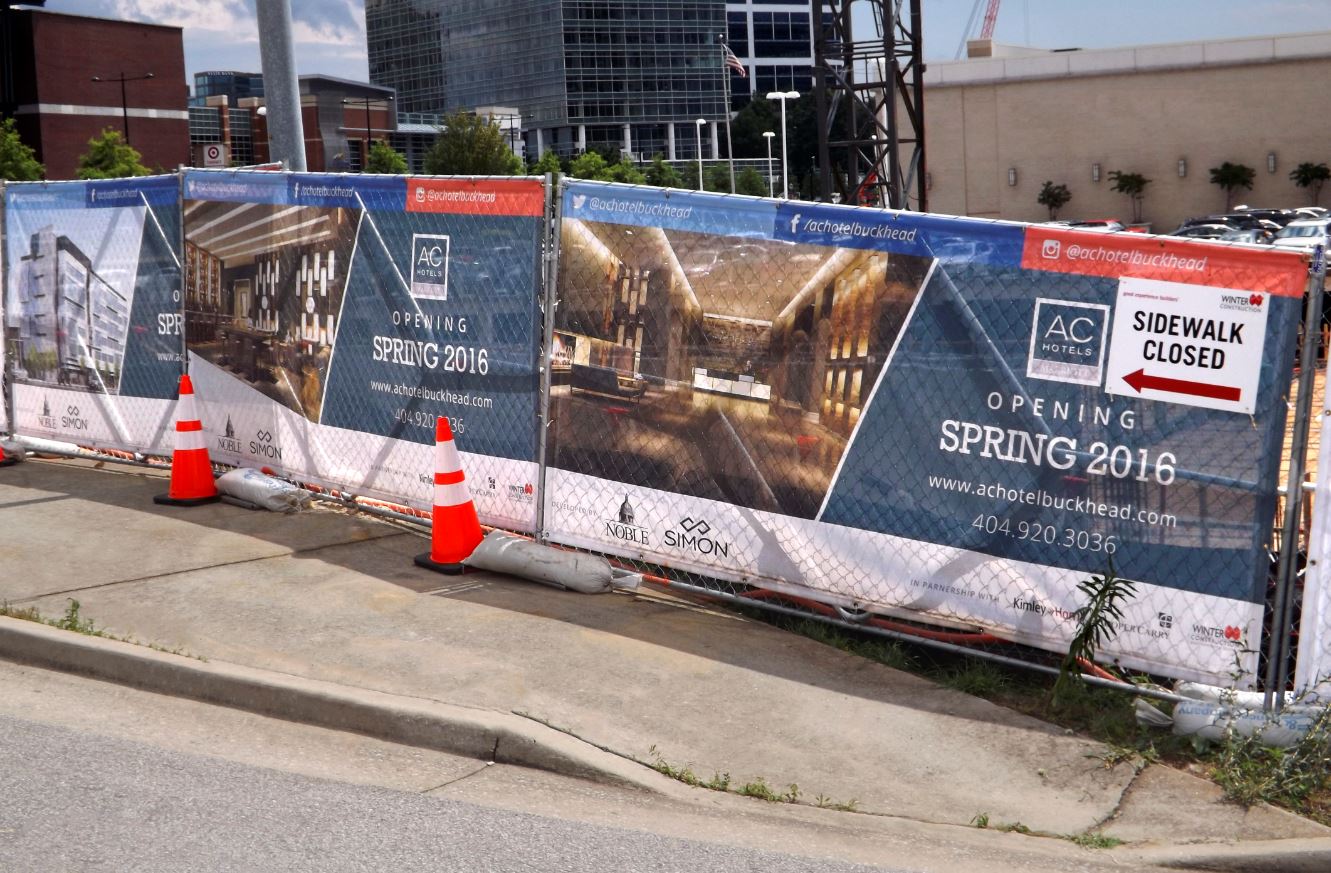
Construction sites are another. Atlanta's skyline is in constant motion, and the temporary fence lines around active sites in Midtown, Buckhead, and along the Westside Beltline are prime branding real estate. Wrapping that fence with mesh banners gives the developer, GC, and trades a continuous brand surface that survives months of weather instead of weeks.
Building wraps and scaffolding covers fall in the same category. A high-rise renovation or facade repair generates a tall, narrow surface that wind absolutely will find. Solid vinyl on that surface is asking for a tear and a liability call. Mesh is the standard for a reason.
Stadium and arena banners — anywhere with sustained directional wind, exposed seating, or open concourses — also benefit. Same logic at car dealerships and outdoor sales lots along Cobb Parkway and Buford Highway, where banners live outside year-round.
What You Trade for the Wind Resistance
Mesh isn't a free upgrade. There are real tradeoffs, and we walk every customer through them before printing.
Color saturation looks slightly muted compared to solid vinyl. The perforations break up the surface, so dense blacks and bright reds don't quite hit the same depth. For most outdoor branding, the difference is invisible at viewing distance — and the viewing distance for a fence-line banner is rarely under twenty feet. For a banner that's going to be photographed in close detail or used as a backdrop on camera, we usually steer customers back toward solid vinyl with proper wind slits.
Backlighting is a non-starter with mesh. Light passes through the holes and washes out the print. If a banner has to be lit from behind at night, mesh is the wrong material.
Mesh also isn't truly opaque. If you stand directly behind a mesh banner during the day, you can see shadowy shapes through it. For most fence and scaffolding applications, that's fine. For privacy screening — say, blocking the view of a job site interior or a back-of-house staging area — mesh works but isn't a true visual block.
How We Build Mesh Banners to Survive Atlanta Weather
The print is only part of the job. The hem, the grommets, and the install hardware are what determine whether a banner makes it through a season or fails in the first storm.
We hem mesh banners with a folded edge and reinforcing webbing rather than a simple heat-weld. Grommets go through the webbing, not just the mesh, so the load gets distributed instead of concentrated at a single hole. For long runs along construction fence, we space grommets tighter than the standard two-foot interval and recommend zip ties or banner ties rated for outdoor UV exposure.
For very tall installations — building wraps, multi-story scaffolding — we'll engineer the panel breaks and overlap pattern with the install crew, because those projects almost always involve a separate rigging team and the print needs to land cleanly across panel seams.
Practical Takeaways
If your banner is going outside, on a fence, on scaffolding, or anywhere wind has a clean path at it, default to mesh. The print quality is more than good enough for branding work, and the durability difference is dramatic.
If the banner is going to be backlit, used as a close-up photo backdrop, or hung indoors, stick with solid vinyl. Mesh has a job and that's not it.
Talk to your printer about hem and grommet construction before the file goes to press. A well-built mesh banner with the right hardware will outlast the event, the campaign, or the construction phase it was made for. A cheap one will fail in a thunderstorm and take your branding down with it.
If you've got an outdoor event, a long fence line, or a building wrap project coming up in the metro, our team has hung enough mesh banners across Atlanta to know what works and what shows up in the lost-and-found at the end of the weekend.
Ready to Get Started?
Contact Extreme Color today for vehicle wraps, signs, banners, and more.
Get a Free Quote