

The Glass Walls Atlanta Built
Walk through any office tower built or renovated in Atlanta in the last fifteen years — Midtown, Buckhead, the Battery, Centennial Yards — and the interior is mostly glass. Glass walls, glass conference rooms, glass huddle spaces, glass executive offices. The architecture loves the transparency. The people working inside don't always agree.
That's where frosted privacy film comes in. It's the quiet solution to a design trend that prioritized openness over privacy, and we install a lot of it across metro Atlanta — for law firms, tech offices, medical practices, marketing agencies, and any business that lives in a glass box.
What Frosted Film Actually Does
Frosted film is an adhesive vinyl applied to the interior side of a glass panel. It scatters light without blocking it, which means a person can still see general shapes and movement on the other side but cannot read a screen, see a face clearly, or watch what's happening in a meeting. The room stays bright. The privacy goes up.
The film comes in different opacities — from a barely-there mist to a fully opaque white. Most office installations land somewhere in the middle: enough frost to obscure faces and screens, not so much that the space starts to feel boxed in. We sample on-site so the client can see how a given opacity reads against their actual lighting and finishes before we cut a full job.
The Standard Privacy Band
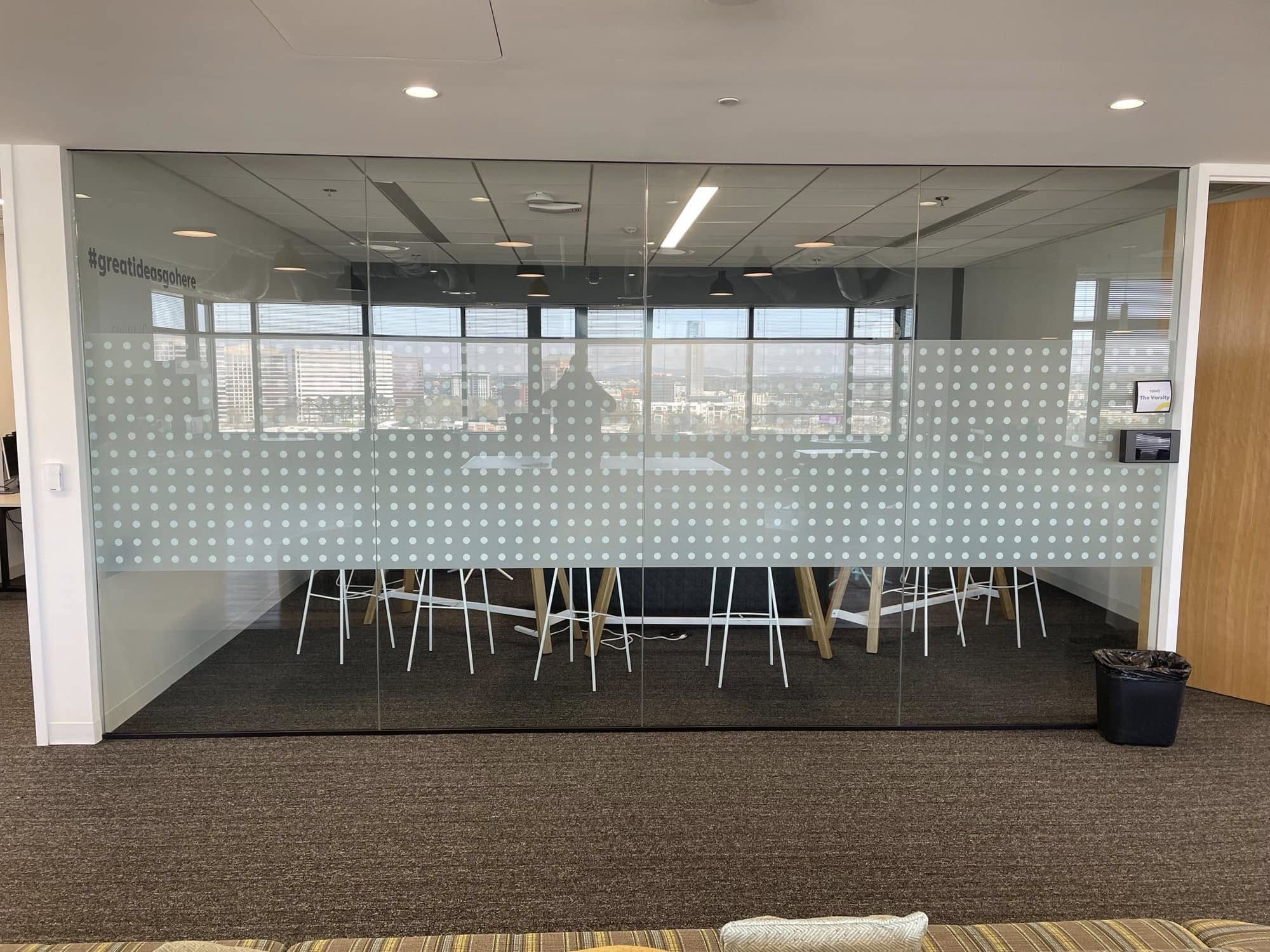
The most common pattern we install is a horizontal band across the middle of the glass — typically running from about 36 inches off the floor to about 60 inches, covering the seated zone. People standing on either side can still see over and under the band, which keeps the office feeling connected. People sitting at the table or the desk are obscured.
This pattern works because it solves the actual problem. The privacy issue in glass conference rooms isn't whether someone can see that a meeting is happening. It's whether someone can see what's on the laptop screens, who's in the room, and what's being written on the whiteboard. The seated-zone band hides exactly that.
Patterns, Gradients, and Branded Designs
Frosted film doesn't have to be a flat rectangle. We cut patterns — geometric, organic, custom — that read as design rather than a privacy fix. Linear gradients that fade from solid frost at the bottom to clear at the top. Dot patterns and lines at varying densities. Custom shapes that reflect the brand or the architecture.
For branded environments, we cut logos and graphics directly from frosted film, so the company mark sits etched into the glass at every conference room door. It reads as architectural detail, not signage. Done right, the film looks like it was specified by the architect — even when it's added years after the building was finished.
Materials and Quality Differences
Not all frosted film is the same. Inexpensive films are thin, peel at the edges, and develop a yellow cast within a couple of years. Quality films are thicker, dimensionally stable, and color-fast. We install commercial-grade decorative films built for long-term interior use, with a service life measured in many years rather than months.
Application matters as much as material. Bubbles, edge lift, and visible seams are installation failures, not material failures. Our crews squeegee with controlled tension, trim with sharp blades, and align seams to grid lines that match the glazing pattern so a multi-panel run reads as one continuous surface.
Where Privacy Film Goes in an Office
Conference room walls are the obvious place, but they're not the only one. We've installed privacy film on executive offices, HR rooms, finance and accounting areas, medical consultation rooms, and the glass partitions between cubicle zones. Anywhere a screen, a document, or a conversation needs to stay between the people in the room.
Interior glass doors are another common application. A frosted band at face height on a glass door gives the person inside privacy without making the door look like a wall. People still know the door is there, still see it open and close, but the room behind it isn't on display.
Day-to-Day Maintenance
Frosted film cleans the same way glass does. A microfiber cloth, a streak-free cleaner, light pressure. The film is durable enough to take normal office cleaning without degrading, though we steer clients away from abrasive pads and harsh solvents that can scratch the surface or attack the adhesive.
If a panel ever gets damaged — someone drives a cart into it, a renovation pulls a section off — we can replace individual panels without touching the rest of the install. That's one of the advantages of film over etched or sandblasted glass: it's a repairable system rather than a permanent change to the glazing.
Adding and Removing
One of the reasons frosted film has taken over Atlanta offices is that it's reversible. A landlord can install it for a tenant, and the next tenant can pull it off and start over. A growing company can change the conference room layout, replace the film with a new pattern, and have the space feel renovated without touching the actual walls.
Removal is straightforward when the install was clean. The film peels off the glass; any residual adhesive comes up with a mild solvent. We handle removals on tenant move-outs and rebrand projects routinely.
Practical Takeaways
If your Atlanta office has glass walls and your team is uncomfortable working in them, the fix is usually frosted film — and usually less expensive and faster than people expect. Start with a seated-zone band on the rooms where privacy matters most. Use real commercial-grade film, not the cheapest option. Have a professional install it — bad installs look obviously bad. And if you're going to do it, treat it as a design opportunity, not just a privacy patch. The same film can carry the brand, refine the architecture, and quiet the room all at once.
Ready to Get Started?
Contact Extreme Color today for vehicle wraps, signs, banners, and more.
Get a Free Quote