

Fine Art Printing Isn't Just for Galleries Anymore
When most people hear "giclee print" or "canvas print," they think of art galleries and photographer studios. But walk into a well-designed law office in Buckhead, a medical practice in Sandy Springs, or a boutique hotel lobby in Midtown Atlanta, and you'll see fine art prints everywhere — custom images on canvas, archival paper, and other museum-quality substrates that transform bland walls into design statements.
Businesses have figured out something that galleries have known for decades: the quality of what's on your walls says something about the quality of everything else you do. A sharp, professionally printed canvas on acid-free materials communicates attention to detail in a way that a framed poster from a big box store never will.
What Makes a Giclee Print Different From a Regular Print
Giclee (pronounced zhee-CLAY) is a fine art printing process that uses high-resolution large format printers to produce images with exceptional color accuracy and detail. The term comes from the French word meaning "to spray," referring to the microscopic droplets of ink the printer deposits on the surface. It's a far cry from standard inkjet output.
The key differences are in the materials and the output quality. Giclee prints use archival-grade inks that resist fading for decades. The substrates — canvas, cotton rag paper, or other acid-free media — are chosen specifically for their longevity and their ability to reproduce color faithfully. When we add a UV protective archival coating on top, the result is a print that holds up for years without noticeable color shift, even in spaces with ambient light exposure.
The resolution matters too. Giclee printing captures fine detail that standard commercial printing misses. Subtle gradients, skin tones, shadow detail, and color transitions all render with a smoothness that makes the image feel alive on the wall. For photography and artwork reproduction, that level of fidelity is the difference between "nice print" and "that looks like the original."
Why Businesses Are Investing in Quality Wall Art
Interior design in commercial spaces has shifted significantly over the past decade. The days of generic stock art in matching frames are fading. Businesses want their spaces to reflect their brand, their personality, and their standards — and custom fine art prints are one of the most accessible ways to accomplish that.
Restaurants along the Buford Highway corridor and in neighborhoods like Inman Park are commissioning custom canvas prints that reflect their cuisine and culture. Medical offices in Marietta and Kennesaw are printing calming nature photography on large-format canvas to create a more relaxing environment for patients. Corporate offices in the Perimeter Center area use gallery-wrapped canvas prints of branded imagery and custom photography to reinforce their identity throughout the workspace.
The ROI is practical too. A gallery-quality canvas print can fill a large wall for a fraction of what original artwork costs, and it can be reproduced across multiple locations for brand consistency. If you're opening a second office or a new restaurant location, you can replicate the same art program without commissioning new originals.
Canvas vs. Paper: Choosing the Right Substrate
The two most common substrates for giclee printing are canvas and fine art paper, and they create very different looks.
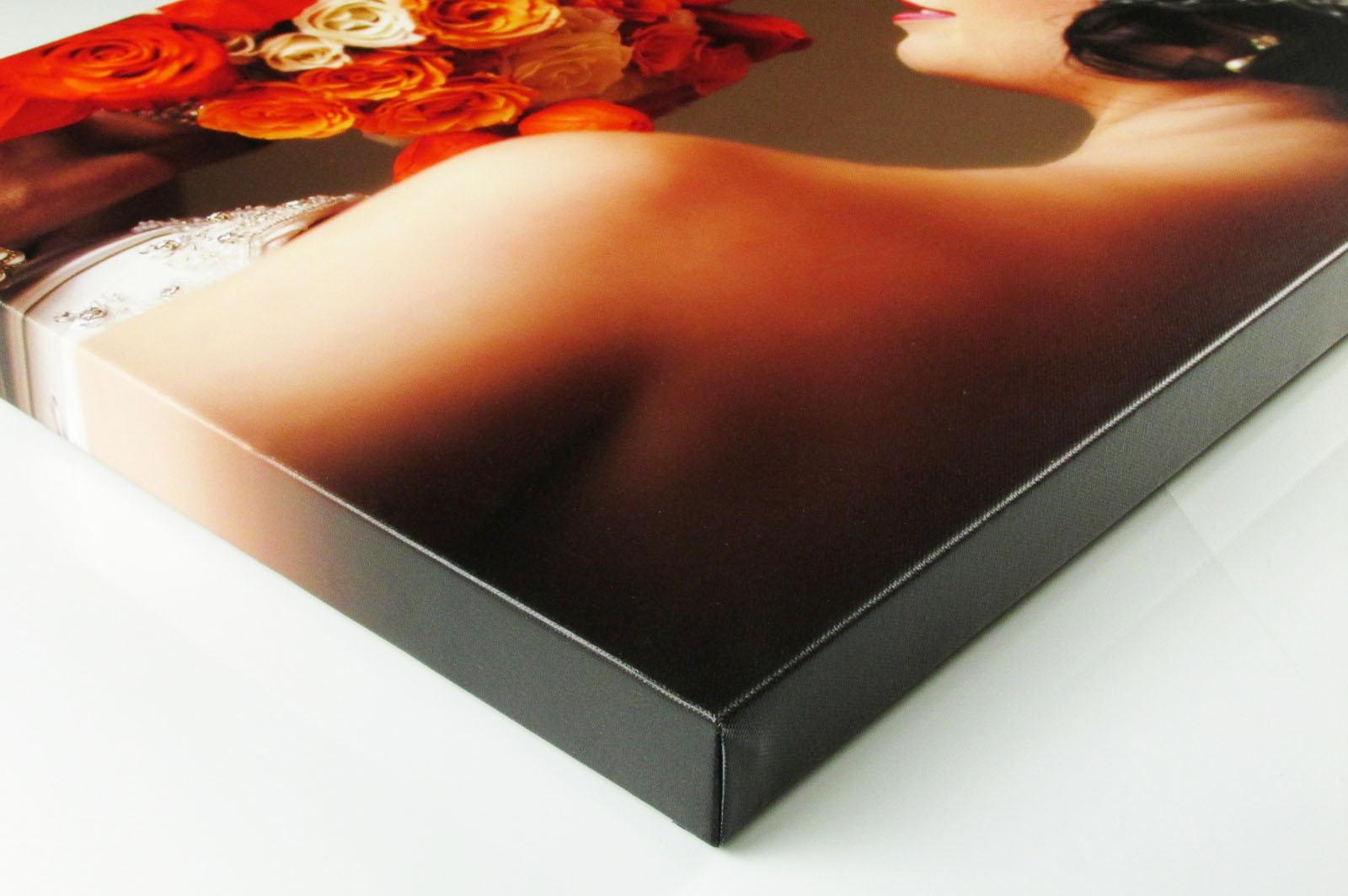
Canvas has a natural texture — a slight weave pattern that adds depth and a tactile quality to the image. It's the standard for gallery-wrap presentations where the image wraps around the edges of the stretcher frame, so no external frame is needed. Canvas prints feel warm, artistic, and substantial. They work well for photography, artwork reproductions, and large-scale images where you want that classic fine art presence.
Fine art paper — typically cotton rag or alpha-cellulose — produces a smoother, more precise image. It's the choice when you want maximum sharpness and color accuracy, particularly for detailed photography or graphic art. Paper prints are usually matted and framed, which gives them a more traditional gallery presentation. They're excellent for corporate environments where a polished, formal look fits the space.
Both substrates accept UV protective coatings that extend the life of the print and protect against environmental damage. The choice between canvas and paper is really an aesthetic decision — neither is inherently better, they just create different moods.
Sizing and Placement for Maximum Impact
One of the advantages of large format printing is that you're not limited to standard frame sizes. A giclee print can be produced at virtually any dimension, which means you can design your art program around your actual wall space rather than trying to make off-the-shelf sizes work.
For commercial spaces, bigger tends to work better. A single large canvas — 40x60 inches or larger — creates a focal point that draws the eye and anchors a room. A series of three or four coordinated pieces can define a hallway or waiting area. The scale should match the space: a small print on a large wall gets lost, while an oversized print in a tight space can feel overwhelming.
Placement height matters too. In spaces where people are primarily standing — lobbies, retail, hallways — center the art at roughly 60 inches from the floor. In seated environments — restaurants, waiting rooms, conference rooms — drop it down to 54-56 inches so it sits at comfortable eye level for people in chairs.
From Digital File to Finished Print
The quality of a giclee print starts with the quality of the source file. High-resolution images — at least 150 DPI at the final print size, ideally 300 DPI — produce the sharpest results. If you're working with a photographer or designer, make sure they deliver files sized for large format output. Upscaling a small web image to fill a 4-foot canvas will produce disappointing results no matter how good the printer is.
Color management is the other critical factor. The colors you see on your monitor are not necessarily the colors that come off the printer. Professional large format printing uses ICC color profiles calibrated to the specific combination of printer, ink, and substrate being used. This ensures that the reds, blues, and skin tones in your image look the way they should on the finished print, not washed out or oversaturated.
Once the print is produced, finishing options include gallery wrap on stretcher bars, mounting and framing, or simply rolling for delivery. Gallery wrap is the most popular for contemporary commercial spaces because it creates a clean, frameless presentation that works on any wall.
Making Your Walls Work for Your Business
Whether you're outfitting a new office in Dunwoody, refreshing a restaurant in Decatur, or building out a hospitality space anywhere in metro Atlanta, custom canvas and giclee prints give you a tool for creating the exact environment you want. The combination of archival materials, museum-quality output, and complete control over size and subject means your walls can finally reflect the same standards as the rest of your business.
Ready to Get Started?
Contact Extreme Color today for vehicle wraps, signs, banners, and more.
Get a Free Quote