

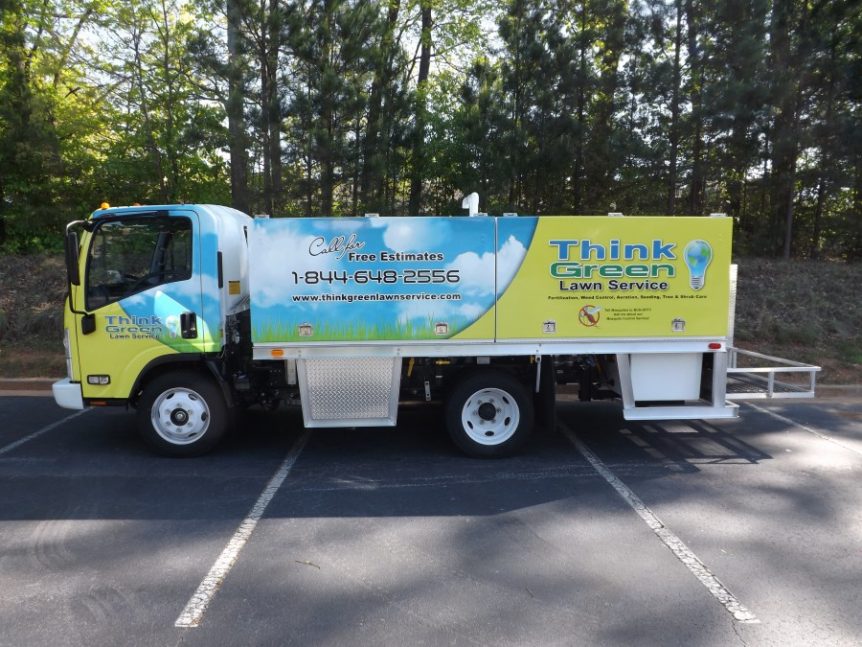
You're Already Driving the Routes — Why Not Advertise While You Do?
If your business runs box trucks, you're sitting on one of the most effective advertising surfaces available — and you're probably not using it. Every day, those trucks roll through Atlanta traffic on I-285, I-85, and surface streets across the metro area, passing thousands of potential customers. A plain white box truck is invisible. A wrapped one is a billboard that goes where your customers are.
Box trucks are uniquely suited for wraps because of their shape. Those big, flat sides are essentially ready-made canvases. Unlike curved car panels or pickup truck bed sides, a box truck gives you clean, uninterrupted space that's visible from a distance. It's the closest thing to a traditional billboard you can put on wheels.
Why Box Trucks Get More Attention Than Cars and Vans
There's a simple reason box truck wraps outperform wraps on smaller vehicles: size. A standard 16-foot box truck gives you roughly 200 square feet of wrappable surface across both sides, the rear, and the front cap. That's more space than most storefront signs and more impressions per mile than almost any other form of local advertising.
The height matters too. Box trucks sit above passenger car rooflines, which means your graphics are visible over traffic. When you're stuck in rush hour on the Downtown Connector or crawling through Buckhead at 5 PM, a wrapped box truck is the most visible vehicle on the road. People in cars, on sidewalks, and in office buildings above the street can all see it.
And unlike a static billboard on the side of the highway, your truck is moving through different neighborhoods throughout the day. A delivery route that takes you from a warehouse near Fulton Industrial Boulevard through Midtown and up to Sandy Springs is hitting three completely different demographics in a single run.
What Goes Into a Box Truck Wrap
A full box truck wrap starts with precise measurements of the vehicle. Even trucks of the same model can have slight variations in body panels, rivet lines, and corrugation patterns. We template the truck to ensure the graphics line up perfectly with the vehicle's features rather than fighting against them.
The design phase is where most of the creative work happens. A box truck wrap needs to communicate your brand clearly at highway speeds — that means someone should be able to identify your company, understand what you do, and catch a phone number or website in about three to five seconds. That's the window you get when a truck passes someone on Peachtree Road.
Effective box truck designs follow a simple hierarchy: logo and company name big enough to read from 50 feet away, a brief tagline or description of your services, and contact information. Photos and detailed graphics can work as background elements, but the text has to be readable first. We've seen too many truck wraps that look great in a design mockup but become an unreadable blur at 45 miles per hour.
The wrap itself is printed on premium cast vinyl using large format printers that produce photographic-quality images. Cast vinyl conforms to the corrugated surfaces of box truck bodies without bubbling, lifting, or peeling. It's then overlaminated with a protective film that guards against UV fading, road debris, and the general wear of daily use.
Full Wraps, Partial Wraps, and Spot Graphics
Not every box truck needs a full wrap. Your budget and your goals should drive that decision.
A full wrap covers every visible surface of the truck body. It delivers the most dramatic visual impact and gives you the most design flexibility. If your truck is an older model with paint fading or minor body imperfections, a full wrap also gives it a fresh, professional appearance — essentially a new paint job that also advertises your business.
A partial wrap covers the most visible areas — typically both sides and the rear — while leaving the cab or roof unwrapped. This approach can reduce costs while still delivering strong brand visibility. For many businesses, a partial wrap hits the sweet spot between impact and investment.
Spot graphics are individual vinyl elements — your logo, phone number, and website — applied directly to the truck body without a full background wrap. This is the most economical option and works well for businesses that want clean, professional identification without the investment of a full wrap.
The Rear Panel: Your Most Valuable Space
Here's something a lot of businesses overlook: the rear of a box truck is the most-seen surface on the vehicle. Think about where you spend most of your time around trucks — behind them. At red lights, in traffic, in parking lots. The rear panel is often visible for extended periods, giving viewers time to actually read and absorb your message.
Design the rear panel like a standalone advertisement. It should work on its own, independent of the side graphics. Include your logo, a clear call to action, your phone number in large text, and your website. If you can only wrap one surface on a box truck, make it the rear.
One practical consideration: make sure your design accounts for the roll-up door, door handles, and any bumper-mounted equipment. These elements break up the visual space, and your design needs to work around them rather than pretending they don't exist.
Durability on Atlanta Roads
Atlanta is tough on vehicles. Between the summer heat, the occasional ice storm, and the construction zones that seem to multiply every year on I-75 and I-20, a box truck wrap needs to hold up under real-world conditions. Quality materials and proper installation are what make the difference between a wrap that looks great for years and one that starts peeling after six months.
Cast vinyl with a quality overlaminate is rated for five to seven years of outdoor exposure, depending on conditions. In practice, box truck wraps in the Atlanta market typically look their best for four to five years before the colors start to show noticeable fading. That's still thousands of hours of advertising for a one-time investment.
Maintenance is straightforward. Regular washing — the same kind you'd give the truck anyway — keeps the graphics looking sharp. Avoid high-pressure washing directly on vinyl edges, and skip the automated truck washes with stiff brushes. A hand wash or touchless wash is ideal.
Measuring the Impact
Vehicle wraps are one of the few forms of advertising where the cost per impression is almost absurdly low. Industry studies consistently show that a wrapped vehicle generates between 30,000 and 70,000 impressions per day in urban markets. In a metro area the size of Atlanta, a box truck running daily routes can generate millions of impressions per year.
The more practical way to measure impact: ask your customers how they found you. Businesses that wrap their trucks consistently report that "I saw your truck" becomes one of the top responses. It's especially effective for service businesses — HVAC, plumbing, catering, moving companies — where the truck is physically present in the neighborhoods you serve.
Making the Move
If you're running box trucks in Atlanta and they're not wrapped, you're paying for advertising space you're not using. The truck is already on the road. The fuel is already burned. The routes are already set. A wrap just turns all of that existing activity into brand exposure.
Start with the trucks that run the highest-visibility routes — the ones hitting major corridors like Ponce de Leon Avenue, Piedmont Road, or the highways circling the Perimeter. Those are the vehicles generating the most impressions, and they're where you'll see the biggest return from a wrap investment.
Ready to Get Started?
Contact Extreme Color today for vehicle wraps, signs, banners, and more.
Get a Free Quote