

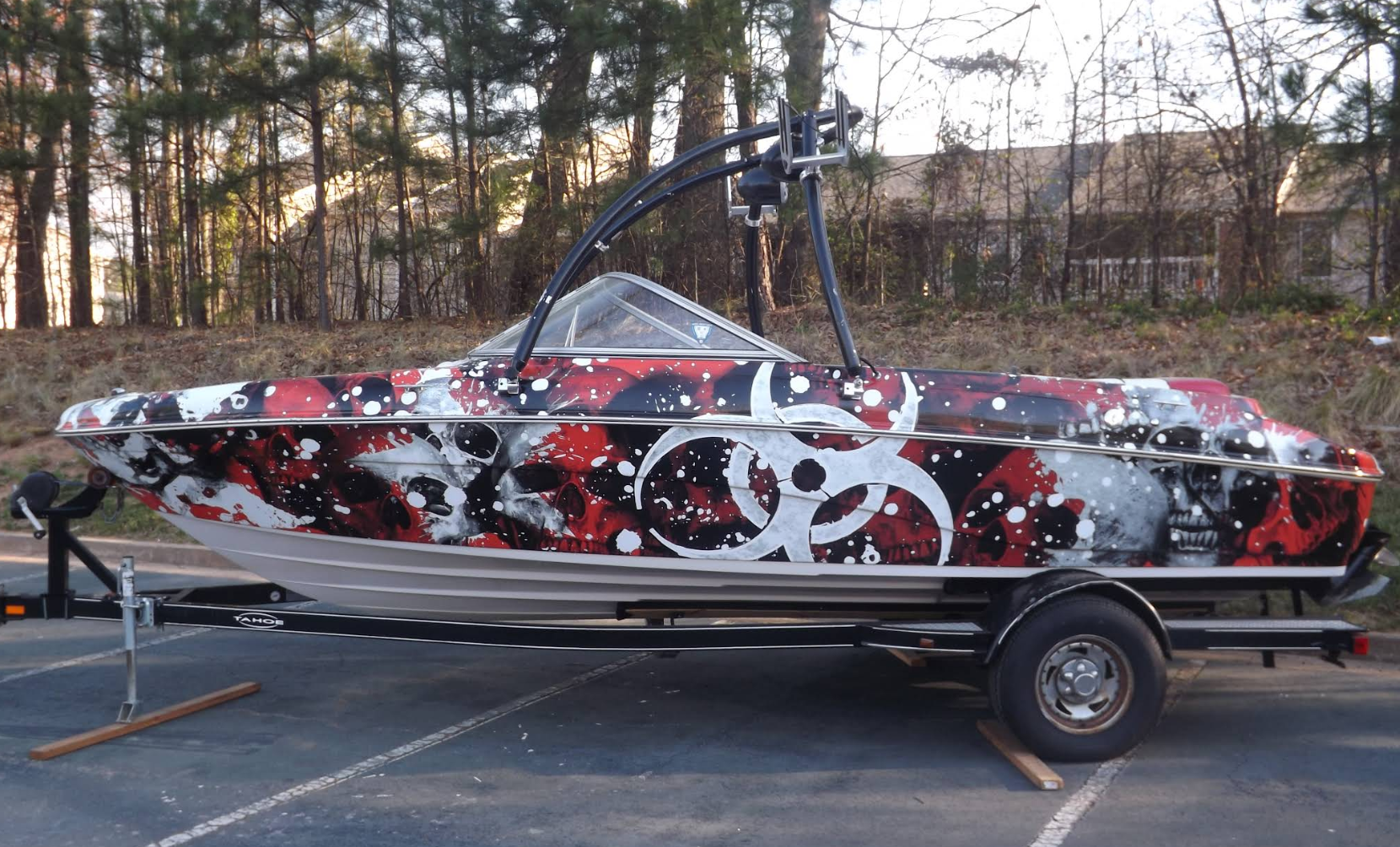
Your Boat Is a Moving Billboard — On the Water and on the Trailer
If you run a charter service on Lake Lanier, a fishing guide operation on Lake Allatoona, or a marine services business anywhere in the north Georgia lake region, your boat is getting seen. On the water, at the marina, on the trailer rolling down GA-400 or I-75 — your vessel is generating impressions whether you're trying to or not. A boat wrap turns that passive visibility into active advertising, and it does it while protecting the hull underneath.
Even for personal boat owners who aren't advertising a business, marine wraps have exploded in popularity. A custom color or design on a boat stands out on the water in a way that factory gelcoat never will. And compared to a custom marine paint job, a wrap is faster, more affordable, and reversible.
How Marine Wraps Differ From Vehicle Wraps
The basic technology is the same — premium cast vinyl printed with high-resolution graphics and overlaminated for protection. But the marine environment adds challenges that don't exist on land vehicles. Constant UV exposure, salt water or mineral-heavy lake water, submersion along the waterline, and the mechanical stress of trailering all push the materials harder than highway use ever would.
Marine-grade vinyl and laminates are formulated to handle these conditions. The adhesive needs to resist moisture intrusion from behind, which can cause lifting and bubbling on standard vehicle wrap films. The overlaminate needs to handle the intense UV that comes with spending all day on open water with no shade. And the installation has to account for the hull's compound curves, strakes, and hardware — boats have some of the most complex surfaces in the wrap world.
Proper surface preparation is especially critical on boats. Gelcoat, even on newer vessels, often has wax residue, oxidation, or surface contamination from marine growth. All of that needs to come off completely before vinyl will adhere properly. Skipping or rushing the prep work is the number one reason marine wraps fail prematurely.
Full Wraps, Partial Wraps, and Graphic Packages
A full hull wrap covers the entire exterior of the boat from gunwale to waterline. This is the most dramatic option and gives you complete design freedom — custom colors, complex graphics, photographic imagery, whatever you want. It also provides a full layer of protection for the gelcoat underneath, shielding it from UV degradation, minor abrasion, and staining.
Partial wraps and graphic packages are more common for commercial vessels. A charter boat might wrap the hull sides with the company name, logo, and contact info while leaving the deck and transom in original gelcoat. A marine services company might do transom lettering and a logo on the bow. These targeted applications keep costs down while still delivering strong brand presence on the water.
Transom graphics deserve special mention because that's the rear of the boat — the face everyone behind you sees, whether you're docked, anchored, or cruising through a no-wake zone. For commercial operations, the transom is prime advertising space. For personal boats, it's where you put the boat name, hailing port, and any registration numbers required by Georgia law.
Design Considerations for the Water
Designing for a boat is different from designing for a truck or a car. The viewing distances are longer — on open water, someone might be reading your graphics from 100 feet or more. Text needs to be large enough to read at distance, and contrast needs to be high so the graphics pop against the water and sky behind them.
Color choice matters more on boats than on land vehicles. Dark colors absorb heat, which is a bigger concern on a hull sitting in direct sun on Lake Lanier in July. Lighter colors or metallics reflect heat and are generally easier on the vinyl adhesive over time. If you do go with a dark hull wrap, using a quality vinyl rated for high heat exposure is essential.
The waterline is the design boundary that takes the most thought. Graphics above the waterline are exposed to sun and air. Graphics at or below the waterline are submerged and deal with different chemistry entirely. Most marine wraps terminate above the waterline, with a clean edge that aligns with the hull's natural break. Wrapping below the waterline requires specialized antifouling materials and is a different conversation entirely.
How Long Marine Wraps Last
In the Atlanta-area boating market, where boats see intense summer sun but aren't in salt water year-round, a properly installed marine wrap typically looks good for three to five years. That lifespan depends heavily on storage conditions — a boat that lives in a covered slip or under a lift canopy will hold up significantly longer than one baking in an open parking lot between trips.
Maintenance is straightforward. Rinse the wrapped surfaces with fresh water after each use, especially if you've been in water with high mineral content or algae. Avoid pressure washing directly on vinyl edges. Use a wrap-safe cleaner for any stubborn spots. Basically, take care of it the way you'd take care of a quality paint job, and it'll reward you with years of clean, vibrant graphics.
When the wrap does reach end of life, removal is clean. The vinyl comes off without damaging the gelcoat underneath — in fact, the gelcoat under a wrap is usually in better condition than exposed gelcoat of the same age because it's been shielded from UV the entire time. That's a real advantage when it comes time to sell or re-wrap.
The Business Case for Marine Branding
For commercial operators on Georgia's lakes and waterways, a wrapped boat is one of the highest-impact marketing investments available. Charter services, fishing guides, boat rental companies, marine contractors, and waterfront restaurants with shuttle boats all benefit from professional marine graphics. You're already on the water — you might as well look like the professional operation you are.
The visibility isn't just on the water. Your boat spends time on a trailer too, and every trip from your storage spot to the boat ramp is a mobile billboard run. A wrapped boat on a trailer driving through Roswell, Alpharetta, or Woodstock on a Saturday morning in boating season is getting thousands of impressions from exactly the demographic most likely to need your services.
Getting Started With a Marine Wrap
If you're considering a wrap for your boat, the process starts the same way as any vehicle wrap — with accurate measurements and a design that works for the specific hull shape. Boats vary wildly in their curves, hardware placement, and surface details, so templating the actual vessel is important. What works on a center console doesn't transfer to a pontoon boat or a cabin cruiser.
Plan your wrap project for the off-season if possible. Late fall and winter are ideal times to have the work done — the boat is out of the water anyway, and you'll be ready to launch with fresh graphics when spring arrives. That timing also tends to work better with production schedules since it's outside the peak season for vehicle wrap shops in the Marietta and Cobb County area.
Ready to Get Started?
Contact Extreme Color today for vehicle wraps, signs, banners, and more.
Get a Free Quote