

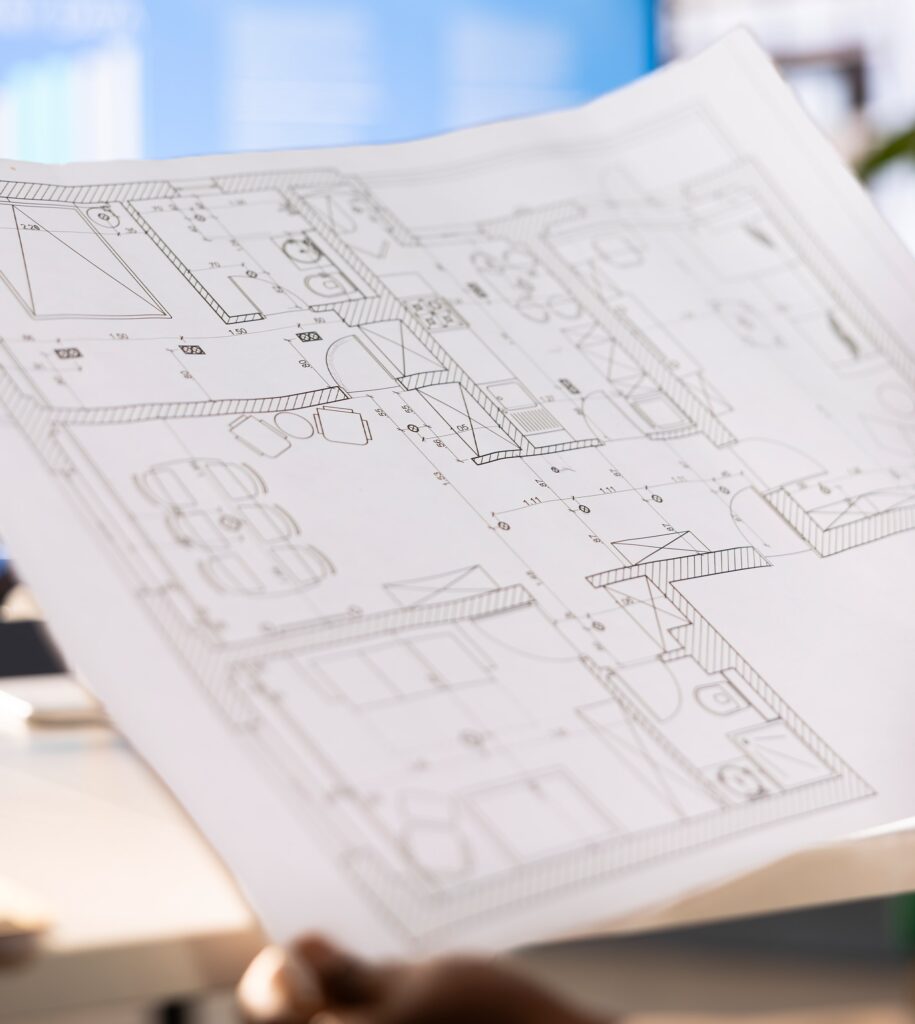
The Plan Set Is Not Dead, It Just Has a Higher Bar Now
Plenty of people assumed that tablets and screens would kill the printed plan set. Walk onto any active job site around Atlanta and you will see otherwise. There is a stack of drawings in the trailer, a rendering pinned up in the sales office, and a site plan rolled out on a tailgate while three people point at the same line. Print did not go away in the architecture, engineering, and construction world. The standards just got higher, because now print has to compete with a screen.
We do a fair amount of large-format work for design and construction firms across metro Atlanta, and the thing that separates a useful plan print from a frustrating one is rarely the thing clients expect. It comes down to scale accuracy, line quality, and matching the output to how the document will actually be used.
Scale Accuracy Is Non-Negotiable
The single most important quality of a plan print is that it is to scale, exactly. When someone puts an architect's scale or a ruler on a printed drawing to check a dimension, the measurement has to be right. A print that is even slightly stretched or shrunk during output is worse than useless, because it looks authoritative while quietly lying about distances.
This sounds obvious, but it is where cheap or careless printing fails most often. Output settings that "fit to page" or rescale a drawing to fill the sheet will throw the scale off. We print plan sets at true scale so the drawing on paper matches the drawing in the file, because in a discipline where a misread dimension can mean a wall in the wrong place, there is no acceptable margin of error.
Line Weight and Legibility Under Field Conditions
Architectural and engineering drawings carry a lot of information in very thin lines, and the difference between a hairline property boundary and a slightly heavier setback line matters. A printer that cannot hold fine line weights crisply turns a precise drawing into a muddy approximation, and the subtle distinctions the drafter built in get lost.
Field conditions make this harder. A drawing that looks fine in the office gets read in a dim trailer, in full Georgia sun, or under work lights at the end of a long day. We print with the contrast and line crispness to stay legible in those conditions, because a plan that only reads well under perfect office lighting is not doing its job on an actual site.
Black-and-White Plans Versus Color Renderings Are Different Animals
One thing worth understanding is that the technical plan set and the presentation rendering are two different print jobs with two different goals. The plan set is about precision: accurate scale, sharp lines, clean text, reliable reproduction across a whole set. Color is secondary or absent.
The rendering is about persuasion. A color elevation, a site rendering, or a presentation board going in front of a client, a zoning board, or an investor needs rich, accurate color and smooth gradients so the materials, landscaping, and light read the way the designer intended. A washed-out or color-shifted rendering undersells months of design work. We treat these as separate workflows because the thing that makes a rendering sing is different from the thing that makes a plan set trustworthy.
The Document Has to Match How It Will Be Used
How a print gets handled should drive how it is produced. A permit set that will be stamped, filed, and referenced occasionally has different needs than a working set that lives in a job-site trailer and gets handled by muddy hands for months. A rendering that hangs in a sales office for a year wants different treatment than one used for a single presentation.
For drawings that take real abuse on site, heavier stock or protective treatments extend their life so they do not turn to pulp halfway through the project. For presentation pieces, mounting and finishing options turn a flat print into something that stands up cleanly at a meeting. The right answer depends entirely on the document's life, which is why we ask how a print will be used before we decide how to make it.
Reproductions, Reductions, and the Whole-Set Problem
AEC work rarely involves a single sheet. It is sets, often large ones, that need to print consistently from the first page to the last. Color and line weight have to hold steady across the whole run so sheet 40 looks like it belongs with sheet 1. Reductions are common too, taking a full-size plan down to a half-size set for easier handling while keeping everything readable and proportionally correct.
Getting a whole set to print uniformly is its own discipline. The value of a print partner who handles plan sets regularly is that the twentieth sheet comes out matching the first, and a half-size reduction stays true to the full-size original. For firms running multiple projects, that reliability is what lets you stop thinking about the printing and get back to the work.
The Takeaway
For Atlanta's architects, engineers, and contractors, large-format printing is still a core part of how the work gets communicated and built. The print has to be exactly to scale, sharp enough to hold fine detail in rough field conditions, and matched to whether it is a precise technical set or a persuasive color rendering. Tell us what the document is, how it will be used, and how it will be handled, and we will produce a plan set or a rendering that holds up from the design office to the job site and back.
Ready to Get Started?
Contact Extreme Color today for vehicle wraps, signs, banners, and more.
Get a Free Quote