

Behind the Scenes: How Georgia Productions Use Large Format Graphics to Build Worlds
Georgia has become one of the busiest film and television production hubs in the country. Between the tax incentives, the diverse landscapes, and the infrastructure that’s built up around the industry over the past decade, productions of every scale are shooting here year-round. And behind every convincing set, every realistic storefront, and every period-accurate backdrop, there’s a good chance large format printing played a role.
We’ve worked with production teams across the state — from major studio lots to independent crews shooting in warehouses and on location throughout metro Atlanta. The work is fast, demanding, and detail-obsessed in ways that most commercial printing never has to be.
What Productions Actually Need Printed
When most people think about movie sets, they picture elaborate physical constructions — wood, paint, plaster. And that’s still a huge part of it. But printed graphics have become an essential layer in modern set design because they deliver photorealistic detail at scales and speeds that traditional scenic painting can’t always match.
Think about a scene set in a hospital hallway. The walls need signage — directional signs, department names, safety posters, bulletin boards with realistic content. None of that is worth building from scratch when it can be printed on vinyl, mounted on foam board or directly applied to walls, and look completely authentic on camera. The same goes for retail environments, office buildings, restaurants, schools — any interior that needs to feel lived-in and real.
Exterior graphics are another major category. Storefront signs, building facades, billboards within a scene, vehicle graphics for picture cars, street-level signage — all of it needs to look convincing from the camera’s perspective, and all of it is typically printed.
The Speed Factor
Production timelines are unlike anything in the commercial world. A set decorator might need a complete suite of hospital signage by Thursday for a Monday shoot. An art director might change a storefront concept after a location scout and need new facade graphics in 48 hours. Scripts change, locations change, creative direction pivots — and the graphics have to keep up.
This is where having a local print partner matters. Productions shooting around Atlanta and across Georgia need a shop that can turn complex graphic packages around fast without sacrificing quality. Shipping graphics from out of state adds transit time and risk. Having a production-experienced team within driving distance of Trilith Studios, Atlanta Metro Studios, or any of the stages scattered around the metro area means faster turnaround and the ability to handle last-minute changes in person.
Materials That Work on Camera
Not every print material reads well on film. Glossy surfaces create unwanted reflections under studio lighting. Materials that are too rigid don’t conform to curved set walls. Vinyl that’s too thin wrinkles under hot lights. Understanding which substrates, laminates, and mounting methods work for camera is specialized knowledge that comes from experience with production work.
Matte finishes are the default for most on-set graphics because they eliminate glare. Fabric prints work well for large backdrops because they’re lightweight, easy to rig, and drape naturally. Adhesive vinyl applied directly to set walls gives the cleanest integration. And for exterior graphics that need to withstand outdoor conditions during a multi-week location shoot, the material conversation gets even more specific.
Color accuracy matters differently on set too. What looks right to the naked eye might shift under tungsten or LED lighting. Experienced production print shops know to factor in the lighting environment and can adjust color output accordingly.
Scale and Scope
Production graphics packages can be massive. A single feature film might need hundreds of individual printed pieces — from tiny desk props and file folder labels to 40-foot building wraps. Managing that kind of scope requires organization, clear communication with the art department, and the production capacity to handle large volumes without bottlenecking.
We’ve produced graphic packages that filled multiple delivery trucks, all coordinated to arrive at specific locations on specific dates according to the shooting schedule. It’s logistics as much as it is printing, and both have to be right.
Period Graphics and Specialty Work
Period pieces present a unique challenge. If a scene is set in the 1970s, every visible sign, poster, label, and printed element needs to feel era-appropriate. That means different typography, different color palettes, different printing “imperfections” that signal the time period. Modern digital printing is almost too clean for period work — sometimes we need to intentionally age or distress graphics to match the era.
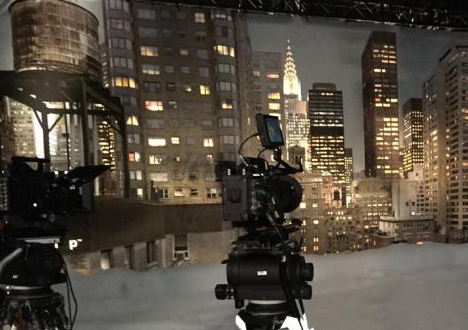
Translite backdrops are another specialty area. These are large-scale backlit photographic prints used behind windows on interior sets to simulate exterior views — cityscapes, landscapes, sky backgrounds. They’re printed on translucent material and lit from behind to create the illusion of depth. Getting the color balance, density, and scale right on a translite is technical work that requires specific experience.
Why Local Matters for Georgia Productions
The Georgia film industry has created a production ecosystem, and having reliable local vendors is a core part of what makes that ecosystem work. When a production designer in East Point or a prop master in Fayetteville needs graphics fast, they need a shop that understands production workflows, speaks their language, and can deliver without the learning curve that a standard commercial printer would face.
We’ve built those relationships over years of production work across the state. Understanding call sheets, working with art department timelines, accommodating script revisions, and delivering production-ready graphics that look right on camera — that’s a different skill set than printing a banner for a grand opening, and it’s one we take seriously.
Ready to Get Started?
Contact Extreme Color today for vehicle wraps, signs, banners, and more.
Get a Free Quote