

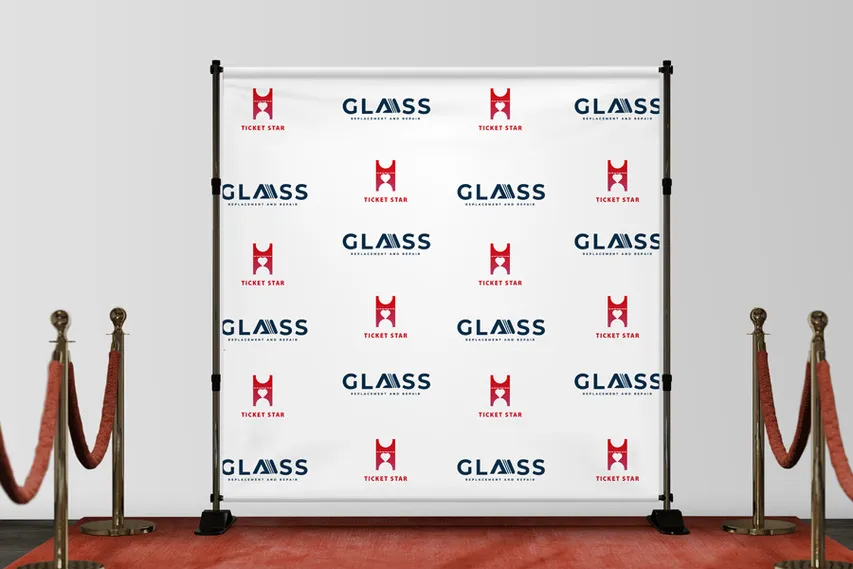
The Banner Behind Every Atlanta Press Photo
Walk through any major Atlanta event venue — Mercedes-Benz Stadium, Pullman Yards, the Fox Theatre, the gala spaces along Peachtree — and you'll see the same piece of large format print over and over: the step-and-repeat. It's the patterned logo wall that becomes the backdrop for every red-carpet photo, every grip-and-grin, every social post that comes out of the event. And it's a piece of print that's gotten a lot more strategic in the last few years.
Our shop produces step-and-repeat banners for galas, premieres, sporting events, corporate kickoffs, and product launches across the city. The brands that get them right understand that this isn't just decoration — it's earned media that lives long after the event is over.
Why "Step and Repeat" Works
The pattern has a job. By repeating the logo across the entire backdrop, the design guarantees that no matter where a photographer crops the shot, at least one full logo appears in the frame. That's the entire point.
This matters because at events, photographers move around. They take wide shots, tight shots, three-quarter portraits, group shots. A single centered logo gets cropped out half the time. A repeating pattern stays in every shot. Multiply that by the dozens or hundreds of photos that come out of an event, and the brand exposure adds up fast.
Sizing and Spacing
The most common mistake we see in step-and-repeat design is logos that are either too big, too small, or spaced incorrectly.
For logos: the typical sweet spot is 8 to 14 inches across for a corporate logo. Big enough to read in a tight headshot, small enough that multiple logos appear in a wider group shot. Sponsor walls with multiple brands need careful weighting so no single brand dominates.
For spacing: most step-and-repeats use a half-drop pattern — alternating rows offset by half a logo width — rather than a perfectly aligned grid. The half-drop guarantees that any horizontal crop or vertical crop still includes complete logos. A straight grid creates positions where photographers can accidentally crop logos in half.
The standard ratio we use is roughly 70 percent logo to 30 percent background space within the pattern, but this varies based on logo complexity and brand color.
Materials and Construction
Backdrops live in two main forms: vinyl banners with pole-pocket grommets for stand systems, and tension-fabric SEG (silicone edge graphic) panels stretched over aluminum frames. Each has its place.
Vinyl banners are cheaper, faster, and easy to roll up and ship. They work well for one-time events, traveling press tours, and quick-turn productions. The downside is that vinyl can show wrinkles, glare under direct lighting, and creases from folding.
SEG fabric on a frame is the higher-end option. The fabric stretches taut over an aluminum frame for a perfectly flat, glare-free, photograph-ready surface. The fabric is washable, replaceable, and stores compactly when you only need to ship the graphic itself between events. Atlanta event production companies who run multiple events a year almost always invest in the SEG system.
Lighting Considerations
A step-and-repeat doesn't exist in isolation. It exists under whatever lighting the venue or production team brings, and that affects how the print looks on camera.
For dark venues with spotlights — black-tie galas, premieres, evening receptions — we recommend a slightly muted color palette and matte finish. Glossy vinyl will reflect spotlights right back into the camera lens. The finish level isn't decorative; it's a photographic decision.
For bright venues with daylight — outdoor activations, daytime press events, sports media areas — high-contrast color and crisp logo edges hold up better. Daylight has a different quality than artificial light, and the right material handles it without washing out.
Sponsor Walls and Logo Hierarchy
For events with multiple sponsors, the step-and-repeat becomes a layout puzzle. Title sponsors expect prominence. Mid-tier sponsors expect parity with each other. Lower-tier sponsors expect at least to appear in shots. Doing this without making the wall look like a NASCAR fender takes real design discipline.
Our typical approach: title sponsor logo larger and in the prime camera position (usually slightly above eye level for standing shots), mid-tier sponsors at consistent size in alternating positions, lower-tier sponsors at smaller scale around the edges. The geometry guarantees that title sponsors are in nearly every shot and lower tiers are in most of them.
Logistics and Lead Time
Event print is unforgiving. There's no version where the banner shows up two days late. We work with Atlanta event planners and PR teams who know that the moment the event date is locked, the print conversation needs to start. Logo files have to be vetted for resolution, sponsor approval has to be pulled, and the actual printing and finishing has to happen with enough buffer for shipping or local pickup.
The events that go smoothly are the ones where the print partner is in the loop early. The ones that scramble are the ones where someone realized at 9 p.m. the night before that the wall is half a foot too tall for the venue's ceiling height.
Quick Takeaways
If you're producing an Atlanta event with a media moment, the step-and-repeat is doing real work. Size your logos for tight headshots, not wide stage shots. Pick fabric over vinyl if you're going to use the wall more than once. Pay attention to the lighting your venue is going to throw at it. And get the print conversation started the moment the date is locked, not the week of.
The wall ends up in every photo. Treat it like a piece of strategy, not decoration.
Ready to Get Started?
Contact Extreme Color today for vehicle wraps, signs, banners, and more.
Get a Free Quote