

The Most Underrated Sign on the Sidewalk
Walk down any commercial stretch in Atlanta, from Ponce City Market to the shops in Virginia-Highland, and you'll see them everywhere: A-frame signs standing guard on the sidewalk. They're so common we stop noticing them, which is exactly why they work. The A-frame, or sandwich board, is one of the oldest tricks in retail, and it's still one of the most effective pieces of curbside marketing a small business can own.
We make a lot of these signs for restaurants, cafes, salons, and shops around the metro, and the reason is simple. A good sidewalk sign catches the foot traffic that a storefront alone can't, and it does it for a fraction of what most advertising costs. Here's how to get the most out of one.
Why Curbside Signs Still Beat the Odds
A storefront sign faces the street. A sidewalk sign faces the person actually walking by, at the moment they're deciding whether to stop. That difference is everything. Pedestrians on a sidewalk are close, moving slowly, and genuinely scanning for somewhere to eat or shop. An A-frame planted in their path is a message delivered at exactly the right instant.
They also punch above their weight on cost. Unlike a permanent sign, an A-frame needs no installation and no permits in the way a building sign might. You set it out in the morning and bring it in at night. For a business testing a location or a promotion, that flexibility is worth a lot.
The Two Kinds of A-Frame
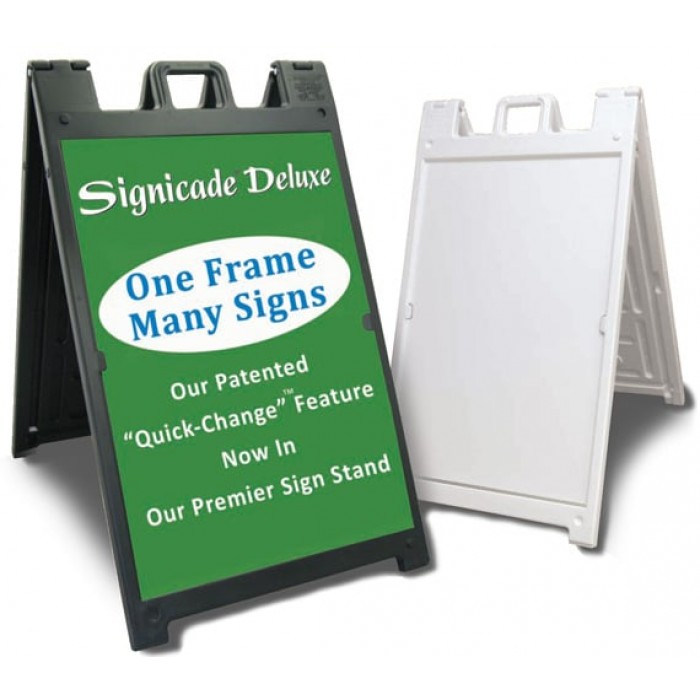
Most sidewalk signs fall into one of two camps, and choosing the right one depends on how often your message changes. The first is the changeable-message board, most often a chalkboard or marker surface, where the staff writes the day's special by hand. These are perfect for restaurants and cafes whose message shifts daily.
The second is the printed-insert frame, where a professionally printed graphic slides into the sign and stays put. This is the choice when your message is stable, your branding needs to look polished, and you don't want to rely on someone's handwriting. Many businesses run both: a printed panel on one side for the brand, a writable panel on the other for the daily hook. Deciding which format fits your message is the first real decision, and it shapes everything after it.
Build for Atlanta Sidewalks and Atlanta Weather
A sidewalk sign lives outdoors and takes a beating. Wind funnels down Peachtree, afternoon storms roll in without warning, and a light sign becomes a sail the moment a gust hits. That's why weight and construction matter. A sturdy frame with a weighted base stays upright; a flimsy one ends up in the gutter.
Material choice matters just as much for the printed graphics. A panel that looks great indoors can fade or warp after a few weeks of Georgia sun and humidity. We build sidewalk signs with outdoor life in mind, matching the frame and the graphic to the reality of sitting on a sidewalk all day. A sign that has to be replaced every month isn't the bargain it looked like.
Design It to Be Read in Three Seconds
The person reading your A-frame is walking, not studying. You have about three seconds and a few strides to land your message. That means a bold headline, a short supporting line, and nothing else. "FRESH BAGELS TIL 11" works. A dense paragraph about your sourcing philosophy does not, no matter how good the story is.
Contrast and size do the heavy lifting. Big type, strong color separation, and plenty of open space read from a distance; cramped, low-contrast layouts disappear. If your sign has a call to action, make it obvious, whether that's a daily special, a discount, or just an arrow pointing to your door. The goal is to convert a passing glance into a stopped pedestrian.
Placement Is Part of the Sign
Even a perfect sign fails in the wrong spot. Position it where foot traffic naturally slows or turns, keep it clear of the pedestrian path so it's not a hazard, and angle it toward the direction most people are coming from. A few feet in either direction can be the difference between a sign people read and one they walk past.
It's also worth knowing your local rules. Sidewalk sign placement is regulated in many parts of Atlanta, and the specifics vary by district and property. Checking what's allowed at your location keeps a helpful sign from becoming a headache.
The Takeaway
The A-frame endures because it does one job extremely well: it turns sidewalk traffic into customers at the moment of decision. For Atlanta storefronts and restaurants, it remains one of the highest-return signs you can buy. Pick the format that fits your message, build it for real outdoor conditions, design it to read in three seconds, and place it where the foot traffic is. We specialize in signage and banners, and a well-made sidewalk sign is proof that the simplest tools are often the ones that pay off most.
Ready to Get Started?
Contact Extreme Color today for vehicle wraps, signs, banners, and more.
Get a Free Quote